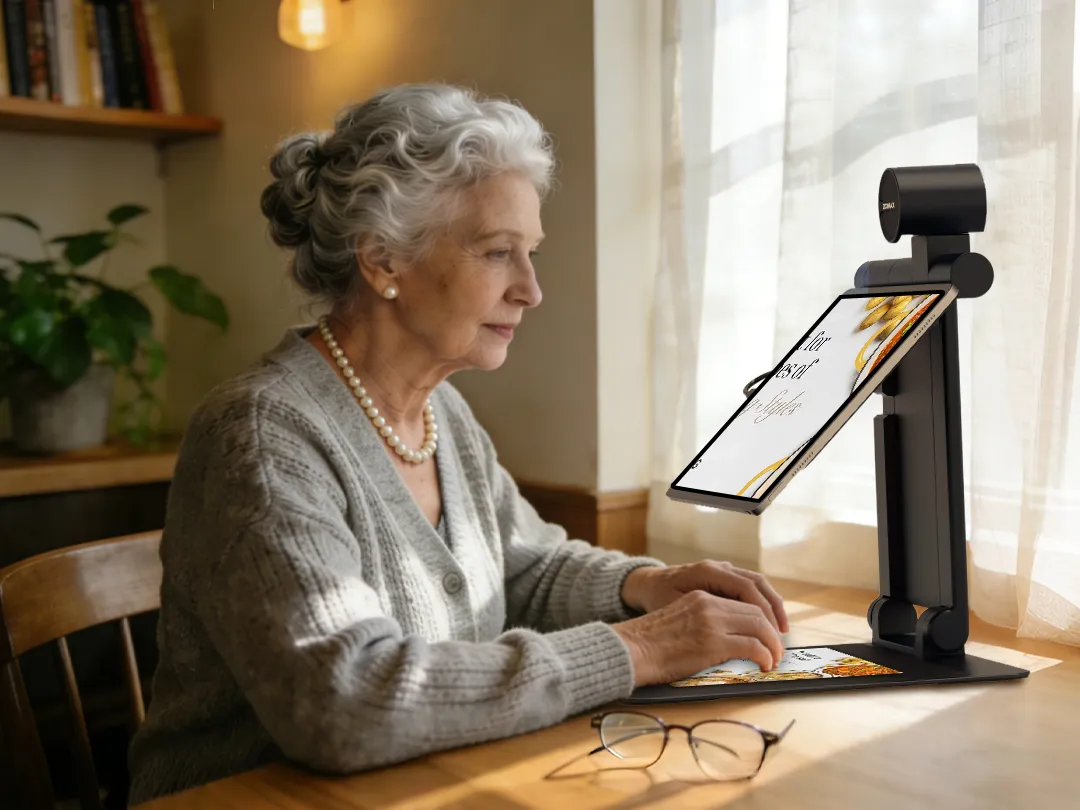

Abstract
In an era of smart wearables, visually impaired individuals face a key choice: Ray-Ban Meta’s consumer smart glasses or specialized medical-grade low vision aids. With 250 million people worldwide living with visual impairment, this decision impacts independence and daily life—making the right solution critical.
Ray-Ban Meta’s sleek design and AI features appeal to many, but generic devices fall short for those with macular degeneration, glaucoma, or similar conditions. Zoomax’s ACESIGHT VR, Luna 6, and other specialized aids excel here, built from scratch with medical-grade functionality tailored to low vision’s unique challenges.
This article explores their key differences, using Zoomax’s lineup to show why “specialization” beats “versatility” for supporting visually impaired users.
Main Body
Ray-Ban Meta vs. professional low vision aids: Which better serves visually impaired users? Compare Zoomax’s medical-grade electronic magnifiers (ACESIGHT VR, Luna 6) for macular degeneration—magnification, low-light performance, customization. Professional solutions lead for moderate-severe loss; Ray-Ban Meta fits mild cases + social connectivity.
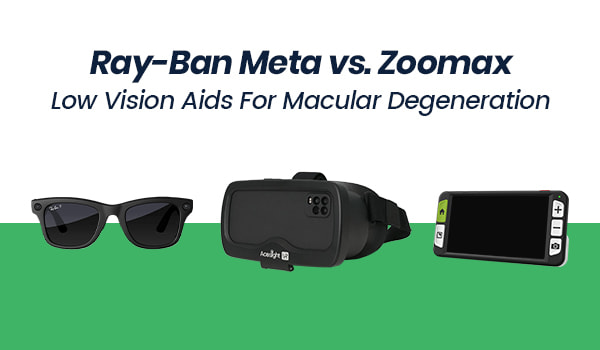
In an era where smart wearables reshape daily life, visually impaired individuals face a critical choice: mainstream consumer smart glasses like Ray-Ban Meta or specialized medical-grade low vision aids? With over 250 million people worldwide living with visual impairment, this decision directly impacts independence, quality of life, and access to essential daily activities—making it vital to choose the right visual impairment solution for specific needs.
Ray-Ban Meta has gained traction for its sleek design and AI-powered features, positioning itself as a versatile everyday tool. Yet for those with profound or specific eye conditions—such as macular degeneration, glaucoma, or retinitis pigmentosa—generic smart glasses often fail to address core needs. This is where specialized devices like Zoomax’s ACESIGHT VR, Luna 6, SNOW 12, and Luna Eye excel: engineered from the ground up to prioritize medical-grade functionality tailored to the unique challenges of low vision.
Today,we’ll dive deep into the key differences between consumer smart glasses and professional low vision aids, using Zoomax’s product lineup as a benchmark to illustrate why “specialization” matters more than “versatility” for supporting visually impaired users.
Low Vision Devices vs. Consumer Smart Glasses: Design Philosophy
At their core, Ray-Ban Meta and professional low vision aids like Zoomax serve entirely different purposes—a distinction rooted in their design philosophy.
Ray-Ban Meta is first and foremost a consumer electronics device crafted for the general public. Its primary features revolve around social connectivity: AI-powered photo-taking, voice assistants, and integration with apps like Be My Eyes for volunteer support. It is said that its low vision assistance is an afterthought, an added feature rather than a core mission. This means its visual enhancement tools are generalized—limited to basic text magnification and environmental description—with no consideration for the nuanced needs of those with specific eye conditions.
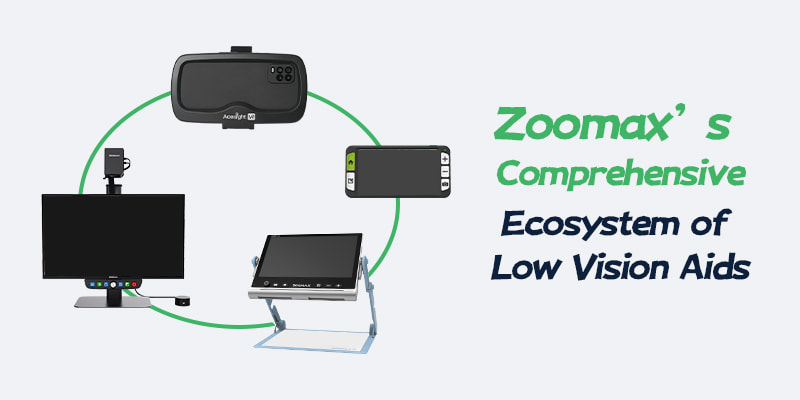
Low vision aids, by contrast, designs every product with a singular focus: “maximizing residual vision” for visually impaired users. Take Zoomax as an example, each device in its lineup targets distinct needs, forming a comprehensive ecosystem of low vision aids:
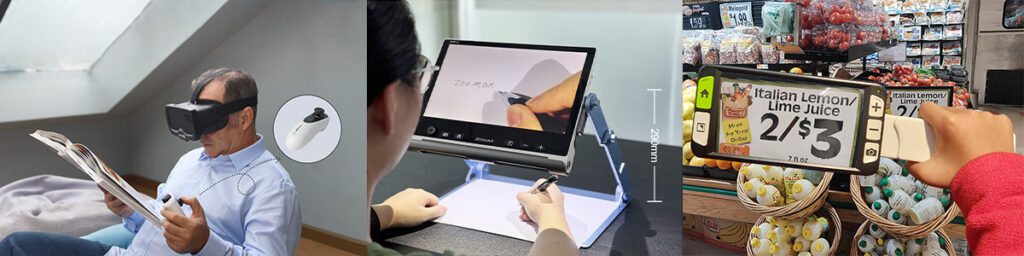
- ACESIGHT VR: An wearable optimized for indoor visual experiences, from watching movies to recognizing faces—ideal for users seeking hands-free low vision devices.
- Luna 6: A portable handheld magnifier perfect for on-the-go reading, such as restaurant menus or street signs—one of the best electronic magnifiers for daily use.
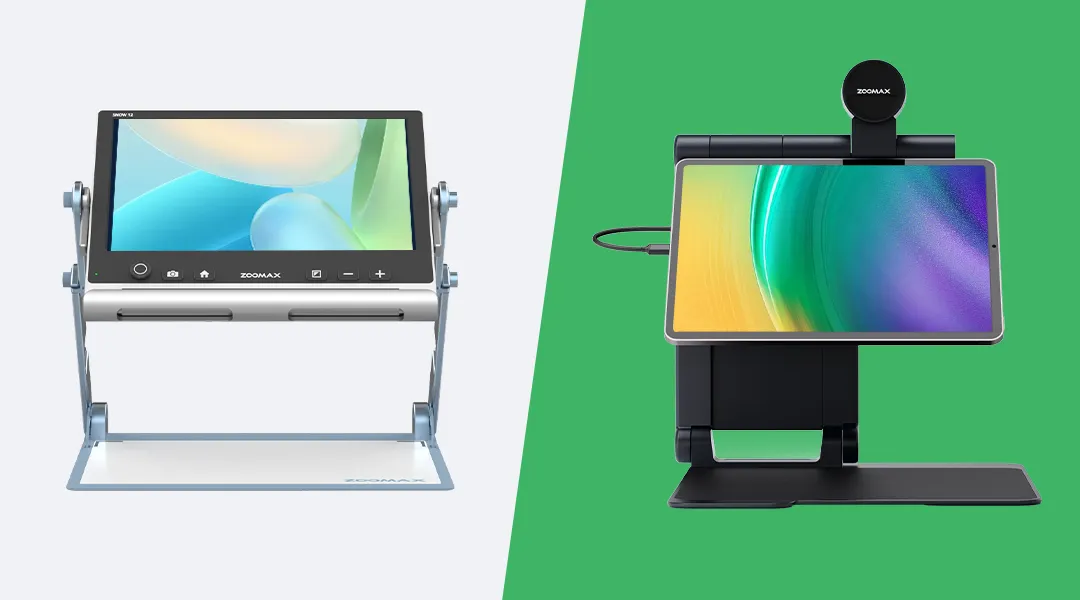
- SNOW 12: A portable digital magnifier built for prolonged tasks like office work or crafting—designed for moderate-severe low vision users needing high precision.
- Luna Eye: A lightweight desktop digital magnifier for multi-task daily activities like reading books, crafting,applying make-up and distance viewing, which is ideal for users who need CCTV vision aids with larger screen and space-saving design.
This specialization isn’t just a selling point—it’s a necessity. Visually impaired users don’t need “one-size-fits-all” tools; they need devices engineered to adapt to their specific condition, whether central vision loss from macular degeneration or peripheral vision impairment from glaucoma.
Low Vision Aid Functionality: Precision vs. Generic Features
When it comes to features that matter most to low vision users—magnification, image optimization, and low-light performance—the gap between Ray-Ban Meta and professional low vision aids becomes stark.
Magnification Power & Image Clarity: Zoomax vs. Ray-Ban Meta
For users with moderate to severe visual impairment, magnification power is non-negotiable. Ray-Ban Meta offers a maximum magnification of 10x, but this usually come with a tradeoff: images often appear blurry or distorted, as the device isn’t calibrated for pathological vision needs, though it appears a great product for people with normal vision.
Zoomax’s devices, by contrast, deliver medical-grade magnification tailored to real-world use—making them the best low vision aids for macular degeneration and glaucoma:
- Luna 6 provides adjustable magnification from 2.5x to 19x, with advanced sharpening algorithms that keep text edges crisp even at high levels. Its ergonomic handle ensures stability, even for users with hand tremors—a common challenge for elderly visually impaired individuals.
- SNOW 12 takes this further, offering up to 19x magnification for desktop use, perfect for tasks like reading small print on medication labels or working on detailed crafts.
Low-Light Performance & Wide Field of View (FOV) for Visual Impairment
One of the most overlooked challenges for low vision users is navigating low-light environments—such as movie theaters or dimly lit rooms. Many people may find that Ray-Ban Meta struggles here: its camera relies heavily on ambient light, leading to grainy, hard-to-distinguish images. Its narrow field of view (FOV) also limits how much of a scene users can see at once, creating a restrictive “tunnel vision” effect.
Zoomax’s ACESIGHT VR addresses this with purpose-built technology, standing out as a top low vision aid for low-light environments:
- Equipped with a high-sensitivity camera and full HD display, it excels in ultra-low light. In a dark movie theater, for example, users can clearly see the entire screen without straining, thanks to low-light enhancement algorithms.
- Its 65° ultra-wide FOV eliminates tunnel vision, providing a panoramic, distortion-free view that mimics natural vision. With a 60Hz refresh rate, motion is smooth—whether watching a fast-paced film or following a conversation across a room.

Condition-Specific Modes for Macular Degeneration & Glaucoma
Unlike Ray-Ban Meta’s one-size-fits-all approach, low vision wearable device like Zoomax Acesight VR offers condition-specific low vision aid modes tailored to common eye conditions:
- ACESIGHT VR includes 4 high-contrast modes and 3 edge-enhancement settings, perfect for users with macular degeneration who struggle to distinguish fine details. For those with retinitis pigmentosa, it helps highlights key elements (e.g., a glass of water or door handle) to simplify daily tasks.For those who suffer from partially viion loss will be able to see the entired picture in the front by entering into Narrow Mode function in Acesight VR.
Ray-Ban Meta lacks these specialized modes, thus users may face the challenge when they try to adapt to a generic tool rather than the other way around.
User Experience: Usability & Reliability for Low Vision Users
For visually impaired users—many of whom are elderly or have limited digital literacy—simplicity and reliability are just as important as technical performance. This is where easy-to-use low vision devices like Zoomax’s lineup shine.
Ray-Ban Meta relies heavily on smartphone integration and AI voice commands, creating a steep learning curve. Users must navigate apps, connect to Wi-Fi, and troubleshoot technical issues—barriers that probably can feel insurmountable for those with limited digital skills. Its dependency on an internet connection also means features like Be My Eyes fail in offline environments, leaving users stranded when they need help most. For people who already mastered the technology could have a trial of it. If that is not the case, low vision aids with easy-to-use features comes as the first choice.
Zoomax prioritizes “no-fuss” usability across its lineup:
- Luna 6 features a one-button design—close the handle to switch to desktop mode, open it for handheld use—no apps or Wi-Fi required. Its long-lasting battery supports hours of use, perfect for users needing consistent assistance.
- ACESIGHT VR comes with a wireless three-button controller, allowing users to adjust magnification, switch modes, and capture images with a simple tap. It operates entirely offline, ensuring reliability in any setting, and its lightweight design makes it comfortable to wear for hours.
- SNOW 12 includes an adjustable desktop stand, letting users position the display at the perfect angle for reading or crafting—reducing neck and eye strain during prolonged use.
Real-World Use Cases: Low Vision Aids in Daily Life
The true test of a low vision aid is how it performs in real-life situations. Let’s compare Ray-Ban Meta and Zoomax devices across three common scenarios:
1. Watching a Movie in a Dark Theater
Ray-Ban Meta’s camera struggles to capture clear images in low light, leaving users squinting at blurry screen content. Its narrow FOV means they can only see a portion of the screen at a time, missing key moments.
Zoomax ACESIGHT VR’s low-light camera and wide FOV transform the experience: users see the entire screen in crisp detail, with adjustable contrast to enhance colors and shadows. Whether it’s a blockbuster film or family documentary, they can fully participate—no more feeling left out.
2. Reading a Restaurant Menu
Ray-Ban Meta’s 10x magnification is often insufficient for small menu text, and its reliance on holding a smartphone steady makes it a bit impractical for table use.
Low vision aids like Zoomax Luna 6’s magnification and stable handle let users easily read even the smallest print. Its high-contrast mode makes text pop against busy backgrounds, and its compact size fits in a purse or pocket—perfect for dining out.
3. Working on a Craft Project at Home
Ray-Ban Meta can’t handle the precision needed for tasks like sewing or painting, as its magnification is too weak and display too small.
Zoomax SNOW 12’s 19x magnification and large display let users see every detail of their work. Its customized stand reduce eye fatigue, making prolonged reading or crafting sessions enjoyable again.
Choosing the Right Visual Impairment Solution: Ray-Ban Meta or Professional Aids?
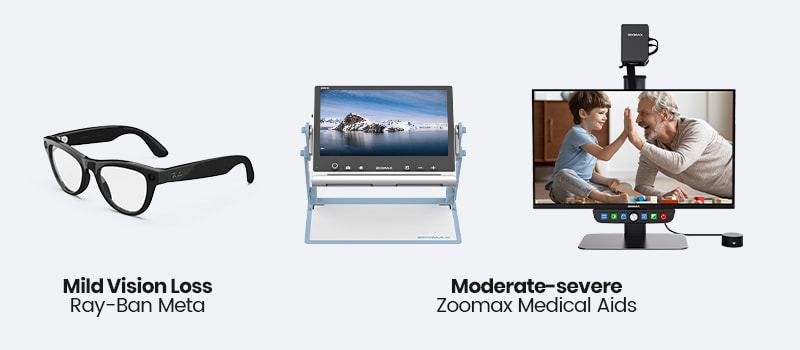
Ray-Ban Meta is not a “bad” device—it is a great product but just not specially designed for the unique needs of visually impaired users. For those with mild vision loss who value social connectivity and multifunctionality, it may serve as a convenient secondary tool. But for anyone with moderate to severe visual impairment, or a specific eye condition, professional low vision aids like Zoomax’s ACESIGHT VR, Luna 6, SNOW 12, and Luna Eye are the superior choice.
Zoomax’s commitment to specialization—from low-light performance to condition-specific modes—ensures that visually impaired users aren’t just “getting by” but thriving. These devices don’t just enhance vision; they restore independence, letting users reclaim activities they love—whether that’s watching a movie, reading a book, or working on a craft.
In the end, low vision users deserve tools engineered for their needs. With Zoomax, that’s exactly what they get: medical-grade precision, user-centric design, and a commitment to making the world more accessible, one specialized device at a time.
Consult Expert for Your Ideal Low Vision Aid
Ready to find the perfect low vision aid for your needs? Contact Zoomax’s team of professional consultants for a personalized assessment—whether you’re seeking low vision aids for glaucoma, macular degeneration, or general visual impairment. Explore our full product lineup—including ACESIGHT VR, Luna 6, SNOW 12, and Luna Eye—and discover how we can help you regain independence. Share your low vision journey in the comments below, and let us know which daily activity you’re most excited to rediscover.
Disclaimer
This article does not constitute medical advice. Always consult a qualified ophthalmologist before choosing a low vision aid.