











If you are dealing with Age-Related Macular Degeneration (AMD), your daily life is likely a series of small, frustrating hurdles. Trying to read a text message, checking the time, or recognizing a friend across the street becomes a task instead of an instinct. It is natural to look toward the future and wonder: “When will the scientists finally solve this?”
As of early 2026, the intersection of Artificial Intelligence (AI) and advanced robotics is transforming ophthalmology. While a “magic pill” for everyone is not yet on pharmacy shelves, the speed of discovery has reached an unprecedented pace. In this comprehensive guide, we will explore the latest research on AI for macular degeneration cure, the rise of robotic surgery, and why current technology—like the high-definition electronic magnifier—is your most essential tool for living a full life today.
1. How Scientists are Using “Digital Copies” of the Eye to Speed Up Research
The biggest problem with finding a cure for AMD has always been time. It takes years to see if a drug works in a human eye. But in early 2026, researchers at the National Institutes of Health (NIH) found a way to bypass part of that wait.
They have developed what they call a “subcellular digital twin” of the eye. Think of it as a highly detailed, 3D computer replica of your retinal cells. According to a February 2026 report from the National Eye Institute (NEI), researchers are using an AI system called POLARIS to watch how these “digital cells” grow and fail.

Instead of testing a new chemical on a live patient, they can test it on 1.3 million digital cells at once. This AI doesn’t just guess; it uses imaging data from thousands of real eye scans to simulate how a disease like AMD will behave over a ten-year period—all in a matter of hours. This is why drug discovery is suddenly moving three times faster than it did just a few years ago.
2. Why Surgeons are Turning to Mechanical Hands for Better Precision
Even the most skilled eye surgeon in the world has a natural, microscopic tremor in their hands. However, the retina is so delicate that a fraction of a millimeter can determine the success or failure of a procedure.
Working at the Micron Level: Where Machines Outperform Hands
Modern medical platforms are now reaching levels of accuracy that were impossible for human fingers to achieve just a decade ago. At institutions like Moorfields Eye Hospital, surgeons are testing systems that can move with a precision of 25 microns—about half the thickness of a human hair.
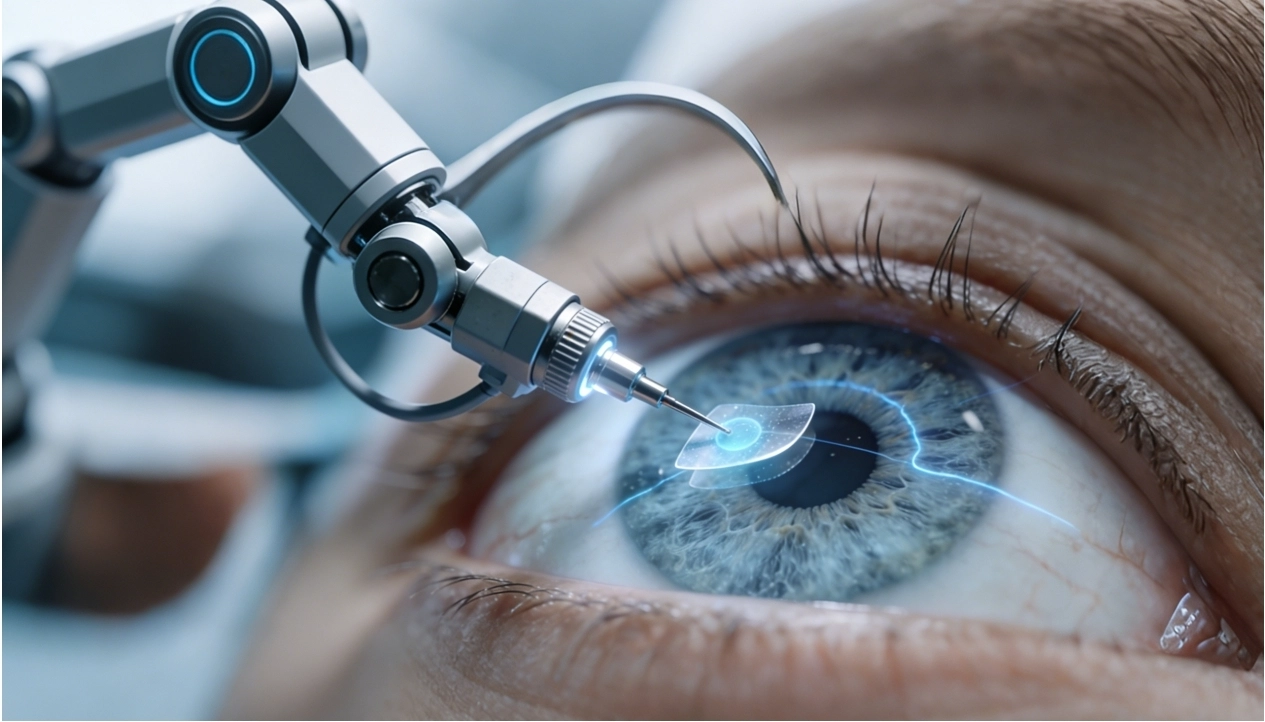
Why does this specific level of accuracy change the game for a cure?
Because the most promising future treatments involve Stem Cell Patches. To fix dry AMD, doctors need to “patch” healthy cells onto the damaged areas of your retina. Without a steady robotic arm, it is almost impossible to place these cells without damaging the surrounding tissue. A major 2025 clinical trial (the PRIMA system) showed that 84% of participants regained the ability to read letters and numbers after receiving a micro-implant under the retina. This proves that if we can place technology or cells in the eye with perfect accuracy, we can actually restore central vision.
3. The Reality Check: Why Your Magnifier is Still Your Best Friend
It is easy to get excited about NIH digital twins and surgical robots. But we have to be honest about the timeline. A successful trial in 2026 often means a drug won’t be in your local clinic until 2029 or 2030.
For someone who wants to read their mail this morning, waiting for a robotic stem cell transplant isn’t a practical strategy. This is why electronic magnifiers (Video Magnifiers) are still the most popular and effective tool for the low vision community.

The Stability of Proven Tech
Current electronic magnifiers have reached a point where the image quality is nearly perfect. You can change the background to high-contrast black and white, which helps if your eyes are sensitive to glare. For most people with AMD, these devices provide an “instant win.” You turn it on, put your book under the camera, and you are reading again.
What specific shifts are we seeing in the next phase of vision aids?
While we don’t have “fully AI” magnifiers on the market yet, they are coming very soon. By the end of 2026, you will start seeing devices that don’t just make the letters bigger—they will actually “interpret” what they are looking at.
Imagine a handheld device that can scan a complex pill bottle and simply say: “This is your heart medication. Take one pill after breakfast.” This “Hybrid Tech” will be the bridge between today’s simple magnification and tomorrow’s medical cures.
4. How Families Can Support Each Other Right Now
AMD doesn’t just affect the eyes; it affects the mind. Losing independence leads to frustration and isolation. If you are helping a family member, the best thing you can do is help them master the tools they have today.
- Don’t wait for the “Magic Bullet”: Many people stop doing things they love because they are waiting for a surgery to fix them. This is a mistake. Using a magnifier keeps the brain’s visual centers active.
- Trust the Experts, Not the Ads: If you see an ad on social media claiming a “secret herbal cure” for AMD, ignore it. Follow organizations like the American Academy of Ophthalmology. Real progress is happening in places like the NIH, and it is documented and transparent.
FAQ: Your Questions About the Future of Sight
Q1: Should I put off buying a magnifier if a cure is coming?
A: No. Medical approvals take a long time. Even if a cure is discovered tomorrow, it will take years to reach the public. In the meantime, your quality of life matters. A good magnifier allows you to stay independent and keep your brain sharp.
Q2: Is AI going to take over the role of my eye doctor?
A: No, but it will make your doctor much better at their job. AI is like a high-powered assistant that can look at your OCT scans and find patterns that are invisible to humans. It allows for “personalized care”—meaning your doctor can tell exactly how your eye is changing.
Q3: Can my diet really help these new treatments work?
A: Yes. Healthy cells need a healthy environment. By eating leafy greens (lutein), taking your AREDS2 vitamins if recommended, and not smoking, you are keeping your retinal “soil” healthy so that future treatments like stem cells have a better chance of succeeding.
Q4: What is the main difference between a “Smart Aid” and a “Medical Cure”?
A: A medical cure tries to fix the eye itself. A smart aid (like an AI magnifier) helps you deal with the eye as it is. Most people in the future will probably use both. You might get a treatment to stop the disease, but you might still use a smart device to make reading tiny text easier.
References:
1. National Eye Institute (NEI): “NIH scientists develop ‘digital twin’ of eye cells to treat AMD” (Published Feb 2026).
2. UCL News / Moorfields Eye Hospital: “Pioneering PRIMA eye device restores reading vision to blind eyes” (Oct 2025).
3. National Institutes of Health (NIH): News Release on POLARIS AI algorithm for RPE image segmentation (2026).