










Executive Summary: The Digital Shift in RP Rehabilitation
- The Optical Limit: Traditional prismatic rp glasses face a “geometric dead-end” due to ring scotomas and image distortion.
- Digital Superiority: Modern retinitis pigmentosa low vision aids use image minification and high-contrast rendering to effectively widen the functional field of view.
- Technical Performance: A 60fps refresh rate is critical in digital magnifiers for low vision to prevent motion blur and nausea for patients with RP tunnel vision.
- B2B Efficiency: Zoomax digital solutions reduce clinician training time and offer quantifiable settings for more precise patient follow-ups.
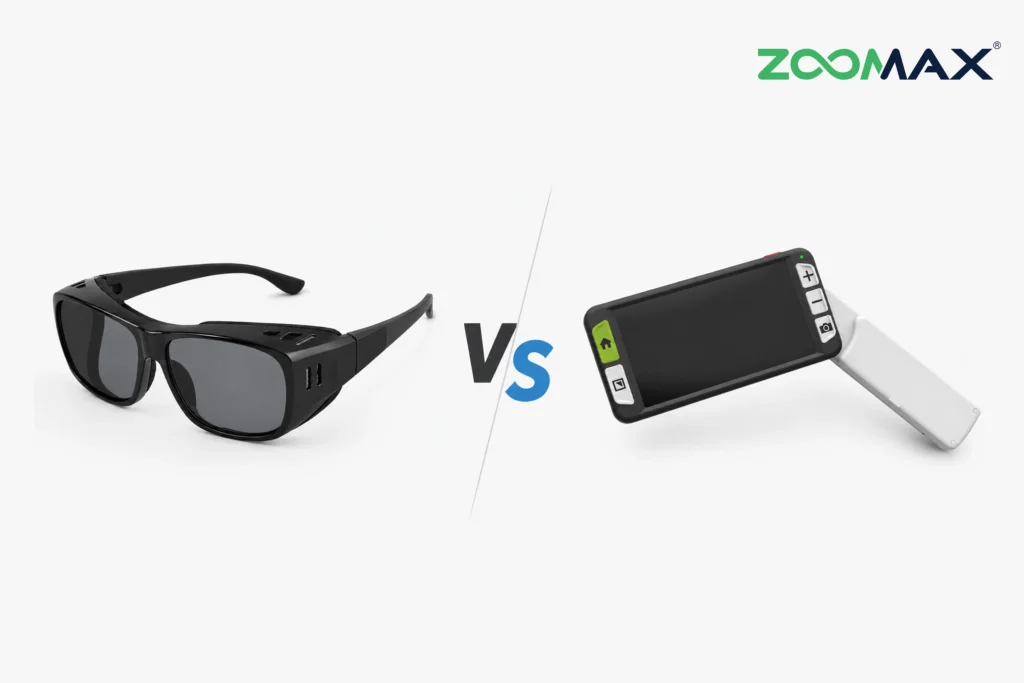
In the specialized field of vision rehabilitation, Retinitis Pigmentosa (RP) remains one of the most complex conditions to manage. For decades, the industry relied on prismatic shifts and optical refraction to assist those with RP tunnel vision. However, we have reached a “geometric dead-end” with traditional optics.
With over two decades of dedicated focus on the low vision industry, Zoomax has become a trusted partner to ophthalmology hospitals and low vision clinics worldwide. Our assistive technology is not merely a product line—it is the daily essential for countless individuals living with retinitis pigmentosa, empowering them to read, navigate, and reclaim independence that optical RP glasses could not sustain. This hard-won clinical trust stems from a fundamental insight: the transition from physical refraction to digital image reorganization is no longer an option, but a clinical necessity. For distributors and eye care professionals, understanding why a digital magnifier for low vision definitively outperforms traditional rp glasses is the foundation of delivering measurably superior patient outcomes and securing a sustainable competitive advantage in the evolving vision rehabilitation market.
The Optical Bottleneck: Why Prismatic Systems Fail in Real-World Scenarios
Traditional low vision glasses for retinitis pigmentosa typically utilize high-diopter prisms to shift images from the blind periphery into the patient’s remaining central field of view. While theoretically sound, this method faces two insurmountable physical hurdles:
The Ring Scotoma Effect: Optical prisms often create a “blind zone” between the shifted image and the natural view, leading to disorientation during mobility.
Chromatic Aberration & Distortion: As the magnification increases in glasses for retinitis pigmentosa, the periphery of the lens becomes subject to severe “pincushion” distortion, making it difficult for users to judge distances accurately.

Unlike physical lenses, a portable electronic magnifier for low vision utilizes a High-Definition (HD) sensor to capture the entire scene, which is then digitally processed and rendered onto a screen. This eliminates the peripheral “smearing” common in prismatic systems.
The Digital Triple-Advantage: Overcoming Tunnel Vision
Modern retinitis pigmentosa ausili per ipovedenti from Zoomax leverage digital processing to solve the “tunnel” problem through three core strategies:
1. Digital Image Minification
While traditional optics focus solely on magnification, RP patients often require minification to fit more visual information into their limited functional field. Digital systems allow users to scale the image down, effectively “widening” their horizon without the bulk of heavy glass.
2. High-Contrast Rendering
RP is frequently accompanied by a loss of contrast sensitivity. Traditional rp glasses cannot alter the light properties of the environment. In contrast, electronic magnifiers for visually impaired users offer multiple color modes (e.g., white on black, yellow on blue) that digitally enhance edge detection, which is vital for navigating stairs or reading.
3. Real-Time Image Stabilization
One of the greatest complaints with high-power optical aids is image “jitter.” Zoomax’s digital engines provide stabilized viewing, ensuring that even at high zoom levels, the image remains steady, reducing the cognitive load on the patient.
Pro Tip for Distributors
When demonstrating products to clinical partners, emphasize the Field of View (FOV) vs. Magnification balance. For RP patients, the ability to see more at once is often more valuable than seeing larger details.
How Digital Strategies Compare to Optical Approaches
Dimensione | Optical Low Vision Glasses | Digital Video Magnifiers |
Field-to-magnification relationship | Fixed inverse ratio; 4× magnification ≈ 75% field reduction | Independently adjustable; wide-angle overview and high-zoom detail in one device |
Contrast & color flexibility | Static spectral filters only | 8–10+ programmable high-contrast color modes with real-time switching |
Motion & refresh performance | Subject to optical distortion, image jump, and vestibular discomfort during head scanning | 60 fps rendering eliminates motion blur; smooth image during device movement and scene scanning |
Disease progression adaptation | Requires re-prescribing, new lens fabrication, and re-fitting | Software-controlled zoom and mode adjustments; no hardware replacement needed |
Prismatic field expansion | Field gain offset by apical scotomas; binocular visual confusion in crowded environments | Digital field-of-view maintained without iatrogenic blind spots or perceptual rivalry |
Learning curve & training burden | 2–4+ clinical sessions for proper use; high discontinuation rate at long-term follow-up | Intuitive interface; typically < 1 session to functional independence |
Contrast sensitivity support | Minimal; limited to tinted filters | Dynamic contrast enhancement with color remapping tailored to RP residual cone function |
Quantifiable outcome tracking | No built-in data capture | Saved magnification, color mode, and contrast settings enable objective follow-up in clinical rehabilitation programs |
Implementing a Digital-First Protocol for RP: Insights from a Low Vision Clinic
A mid-sized low vision clinic in the eastern United States, serving approximately 200 retinitis pigmentosa (RP) patients annually, integrated Zoomax digital magnifiers into its rehabilitation protocol in early 2025. Prior to this shift, the clinic had relied primarily on optical solutions—bioptic telescopes, prismatic field expanders, and high-power reading glasses—for patients with severely constricted visual fields.
Over time, the limitations of an optical-only approach became increasingly evident. The clinic’s senior optometrist reported high discontinuation rates, particularly with prismatic and telescopic devices. Many patients stopped using their prescribed aids due to poor real-world usability, despite substantial initial investment and multiple training sessions.
To close this gap, the clinic implemented a digital-first protocol. All RP patients presenting with a visual field of ≤20° were trialed on Zoomax devices, including handheld digital magnifiers for mobility and environmental scanning tasks, as well as larger-format systems for sustained reading and productivity. Training was standardized into a single 45-minute session covering core functions, display modes, contrast adjustment, and task-specific presets.
Six-month follow-up data from 32 patients demonstrated clear, measurable improvements:
- Sustained reading speed rose from 48 wpm to 92 wpm (+92%).
- Daily device usage increased from 23% to 87% (+64 percentage points).
- Patient satisfaction scores improved from 4.1 to 8.6 on a 10-point scale.
- Required training sessions dropped from 3.2 to 1.1 per patient (−66%).
Operational gains were equally notable. The reduction in training burden freed approximately 14 clinical hours per month, enabling the care team to expand new patient intake and enhance follow-up services. The clinic also recorded a marked increase in patient referrals driven by positive word-of-mouth, further solidifying its reputation as a leading RP rehabilitation center in the region.
Strategic Commercial Value: Why Zoomax is the Preferred Choice
For clinics and distributors, the shift of trends in assistive technology toward low vision aids for retinitis pigmentosa that utilize digital platforms offers significant business advantages:
Reduced Clinical Labor Costs
Traditional prismatic systems require extensive “fitting” sessions and a high degree of patient adaptation training. Zoomax products, such as our handheld video magnifiers, feature ergonomic designs that patients can master in minutes, significantly reducing the billable hours required for rehabilitation training.
60fps High Frame Rate: The Gold Standard
A common pitfall of lower-end digital devices is “ghosting” or lag. For an RP patient, image lag causes immediate dizziness. Zoomax devices utilize a 60fps (frames per second) refresh rate, ensuring that motion remains fluid. This technical specification is a critical selling point when competing with entry-level consumer electronics.
Quantitative Follow-up Support
Digital devices allow for “traceable” settings. When a patient returns for a follow-up, practitioners can see exactly which magnification levels and contrast modes the patient prefers. This data-driven approach provides a level of precision that rp glasses simply cannot match.
Recommended Solutions: Zoomax Precision Tools for RP Care
Zoomax addresses the full spectrum of RP visual needs through two complementary devices, each optimized for distinct use scenarios.
Zoomax Luna 6: The Pocket Field-of-View Compensator
Core Technical Specifications & Versatile Design
Il Luna 6 handheld video magnifier delivers the core specifications that matter most for RP tunnel vision mobility: a 5.5-inch high-definition LCD display (1280 × 720 resolution), magnification from 2.5× to 19×, a 13-megapixel autofocus camera, e 10 high-contrast color modes in addition to full-color viewing. The built-in foldable handle activates distance-view mode, allowing the user to quickly shift between near tasks and distance viewing without the narrow-window swapping that optical telescopes demand.
Targeted RP Applications: Beyond the Narrow Window

For an RP patient standing at a bus stop, this means the difference between catching the route number in a fleeting glance — by simply unfolding the handle and pointing — versus missing it entirely while scanning through a constricted field. In a supermarket aisle, where price tags and product labels lie scattered beyond the narrow visual island, the Luna 6’s autofocus camera e one-touch freeze-frame function let the user capture and inspect information without the exhausting head-sweeping choreography that tunnel vision imposes.
Portability and Environmental Adaptation
At approximately 210 grams, the rechargeable Luna 6 fits into a jacket pocket or bag, making it a true pocket-size video magnifier for spontaneous use in outdoor and transit environments. For RP patients who need rapid environmental scanning, the Luna 6 functions as a portable field expander that complements the user’s natural head-scanning behavior. Crucially, the high-contrast color modes (such as white-on-black or yellow-on-blue) overcome the low-contrast haze that RP patients experience in dim lighting, restoring visibility to curbs and street signs.
B2B Strategic Value: Scalable Clinical Dispensing
For B2B buyers: The Luna 6’s portability and intuitive operation make it an ideal entry-level device in any RP product portfolio. Its low training requirement enables high-volume dispensing with minimal clinician involvement — a compelling value proposition for high-throughput low vision clinics and multi-site rehabilitation networks.
Zoomax Snow Pad: The Intensive Reading and Productivity Workstation
Advanced Visual Compensation for Intensive Reading
For RP patients whose daily activities involve sustained reading, academic study, or professional work, the Tampone da neve mag&read low vision tablet provides a larger-format, hands-free viewing experience. With 32× magnification, a foldable design for portability, and integrated OCR/text-to-speech (TTS) capability, the Snow Pad serves as a versatile platform that bridges the gap between a portable handheld electronic magnifier for low vision and a full desktop CCTV system.
Combating Visual Fatigue with OCR/TTS Technology

Il OCR/TTS feature scans text and reads it aloud — an essential capability for RP patients whose visual fatigue limits sustained reading sessions. Consider an RP university student: as the visual field narrows, tracking from the end of one line to the start of the next becomes a frustrating hunt. With Snow Pad’s line markers and text-to-speech, the student can visually follow highlighted passages while listening, or switch entirely to auditory delivery when their eyes tire, turning an impossible task into a manageable routine.
Workflow Optimization & Seamless Tech Integration
The Snow Pad’s split-screen functionality enables simultaneous recipe reading and note-taking — a workflow that, for an RP user, would otherwise demand constant, disorienting gaze shifts. Its tablet compatibility means it integrates into existing technology ecosystems rather than requiring users to learn an entirely new platform.
Value for Education and Vocational Rehabilitation
For educational institutions and vocational rehabilitation programs: This familiarity reduces the technology abandonment rate that plagues many specialized assistive devices. A working adult with RP can review printed reports while composing emails on the same screen without the visual vertigo induced by optical magnifiers, maintaining productivity and workplace inclusion as their condition progresses.
The future of RP rehabilitation lies in the transition from “bending light” to “processing data.” By integrating retinitis pigmentosa low vision aids that prioritize digital flexibility, providers can offer a quality of life that traditional optics have failed to deliver.
For distributors and institutional buyers, the commercial rationale extends far beyond individual product performance. Zoomax brings two decades of specialized low vision expertise to the challenge of retinitis pigmentosa, with digital magnification solutions purpose-built to address the progressive tunnel vision e contrast loss that optical RP glasses cannot resolve. Trusted in more than 80 countries and backed by international certifications including CE, FDA, and RoHS, our devices have become daily essentials for thousands of RP patients worldwide—delivering the quantifiable visual outcomes and long-term adherence data that modern healthcare systems demand. We reinforce this clinical impact with after-sales support, a comprehensive 2-year warranty, and dedicated partner resources spanning product training, marketing collateral, and channel development.
For clinics, distributors, and rehabilitation networks, choosing Zoomax means gaining more than a manufacturer; it means partnering with a proven, long-term ally committed to advancing RP vision rehabilitation and building sustainable low vision solutions alongside your business.
Are you ready to upgrade your low-vision portfolio? Contact Zoomax low vision aid supplier today to learn more about our distribution partnerships and clinical support programs.