










Fatherhood, Functional Vision, and the Growing Need for Aging Workforce Solutions
The workforce is aging faster than many organizations realize. Globally, approximately 1.1 billion people are aged 60 and older as of 2024, representing about 14% of the total population, while workers aged 55 and older make up roughly 15% of the global labor force.
Many middle-aged and older professionals—including fathers balancing careers and family responsibilities—remain active in today’s workforce in leading meetings, reviewing documents, managing households — while quietly contending with progressive vision loss. Age-related macular degeneration (AMD), diabetic retinopathy, glaucoma, and general visual fatigue do not pause for career responsibilities or family moments. These fathers need more than occasional magnification; they need reliable aging workforce solutions that keep them functioning across digital workplaces and daily routines, acting as true aids for visually impaired seniors. As Father’s Day 2026 approaches, the question of how to best support them becomes especially meaningful.

Why Traditional Low Vision Aids Fail the Aging Workforce
For many working fathers in their 50s and 60s, the first and often only response to fading eyesight is a pair of stronger reading glasses or a basic handheld magnifier. While these traditional optical aids offer momentary enlargement, they quickly turn into productivity traps in any modern work environment.
A 55-year-old accountant with early AMD may find himself craning inches away from spreadsheets, struggling to pull a single clear number from a distorted central blur. The fixed focal length forces him to constantly bob his head between the monitor and the printed ledger — a mechanical, tiring rhythm that builds neck strain and eye fatigue within the first hour.
A 50-year-old attorney with progressing cataracts struggles to cross-reference a contract on screen against printed case notes under harsh fluorescent light. Overhead glare strips away contrast, and the fixed focus of his reading glasses forces a mechanical, exhausting rhythm between screen and page. Well before the morning ends, visual fatigue erodes the sharp concentration his work demands.
These makeshift routines don’t just sap efficiency — turning a quick report review into a halting, error-prone ordeal — they can increase fatigue, reduce task efficiency, and make daily work more challenging. In the end, basic optical aids fall decisively short, confirming that today’s professionals require far more than simple low vision products for visually impaired seniors — they need a complete solution for low vision that works with their eyes, not against them.
What This Shift Means for Clinics and Distributors
These challenges are not only affecting end users. They are also reshaping how clinics and distributors evaluate low vision solutions. As low vision care moves from isolated magnification to functional independence, clinics and distributors need to evolve their approach. Assessment should go beyond visual acuity and instead map how aging users navigate real digital workflows — handling screen transitions, processing documents, participating in meetings, and taking notes. The priority becomes identifying solutions that sustain complete, end‑to‑end task capability, because rehabilitation success is increasingly measured by real‑world outcomes: continued employment, maintained independent living, and reduced caregiver load.
For distributors, this shift reshapes purchasing decisions. Curating assistive technology devices for low vision that directly address the aging workforce — and that support standardized, repeatable training — can improve user adherence and strengthen clinical reputation. Stocking devices built for these outcome‑driven models creates meaningful differentiation in a market that has already moved past basic magnification. The practical takeaway is clear: invest in a solution for low vision that makes functional productivity the benchmark, not just enlarged text.
How Zoomax Snow Pad Delivers Practical Aids for Visually Impaired Seniors Professionals
Zoomax has crafted the Snow Pad as a powerful portable tablet screen magnifier with a discreet, non‑medical design tailored for real‑life productivity. Its ergonomic, adjustable stand lets users set the optimal viewing angle, significantly reducing neck and shoulder strain during extended work sessions. Rather than bolting accessories together, Snow Pad brings core working needs into a single, sleek tablet‑like device that moves effortlessly from desk to meeting room to client site — empowering aging professionals to adopt it with minimal training and making it one of the most practical and unobtrusive aging workforce solutions available today.
Dual‑View Split Screen — One Device, Two Perspectives

Snow Pad allows users to switch seamlessly between distance viewing and reading tasks while leveraging tablet-based multitasking features. During a meeting, the left side of the display locks onto the presentation screen across the room with the distance lens, while the right side magnifies the user’s own notebook, printed agenda, or contract. No switching devices, no missed information. For fathers who must track presentations while taking notes or referencing documents, this dual‑view flow turns a potentially stressful situation into a controlled, natural routine.
Tablet Ecosystem, Zero Learning Curve
Because Snow Pad App runs on a familiar tablet‑style operating system, most users navigate it as easily as they do their personal smartphone or tablet. Touch gestures, high-contrast large icons, and straightforward menus remove the intimidation factor often associated with assistive technology. The result is faster adoption and less reliance on repeated training — a critical advantage for busy working adults who need to get on with their day.
Built‑in OCR and Text‑to‑Speech — Eyes‑Off Reading When Needed
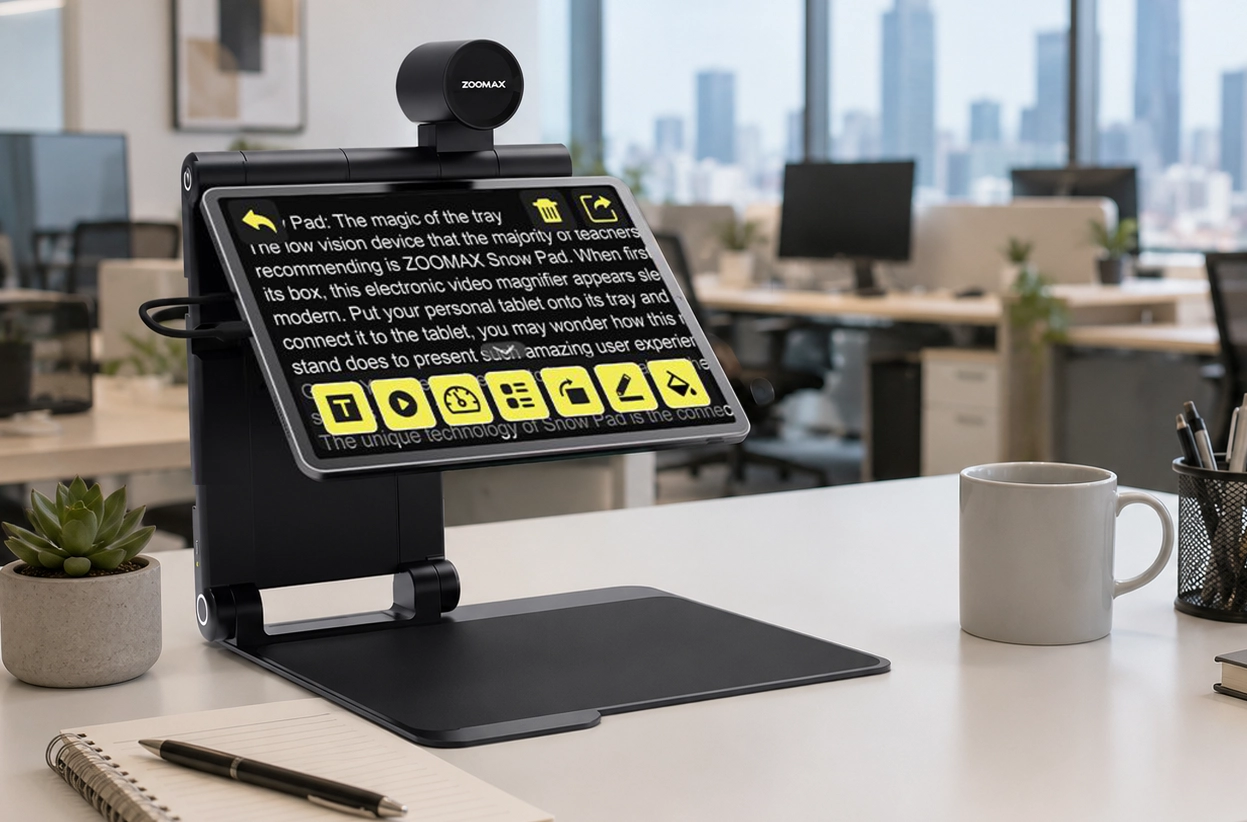
Sustained close reading exacerbates visual fatigue, especially with AMD or diabetic retinopathy. Snow Pad’s integrated optical character recognition (OCR) captures printed text from documents, labels, or books and converts it into high‑quality speech. Users can listen to a contract, a report, or a training manual while resting their eyes, then switch back to magnification for detailed visual review. This flexible “read with ears, verify with eyes” workflow meaningfully lowers daily eye strain and extends functional stamina — essential for independent living aids for the visually impaired.
Combined, these capabilities position Snow Pad as a genuine productivity partner for seniors who refuse to let vision loss define their limits, while also significantly boosting their independence and confidence in the workplace.
This Father’s Day, Bring Support That Keeps Him in the Picture
This Father’s Day 2026, while you celebrate the man who taught you resilience, consider giving him a tool that honors his drive to stay active and self‑sufficient. Whether you represent a clinic seeking to equip
more mid-career and older working professionals, a distributor looking to grow a meaningful category, or a son and daughter wanting to place real capability in your father’s hands — Zoomax Snow Pad bridges affection and function.
Join Zoomax as a partner and provide practical, high-demand solutions for visually impaired seniors. Contact us to learn about distribution opportunities and customized support services.