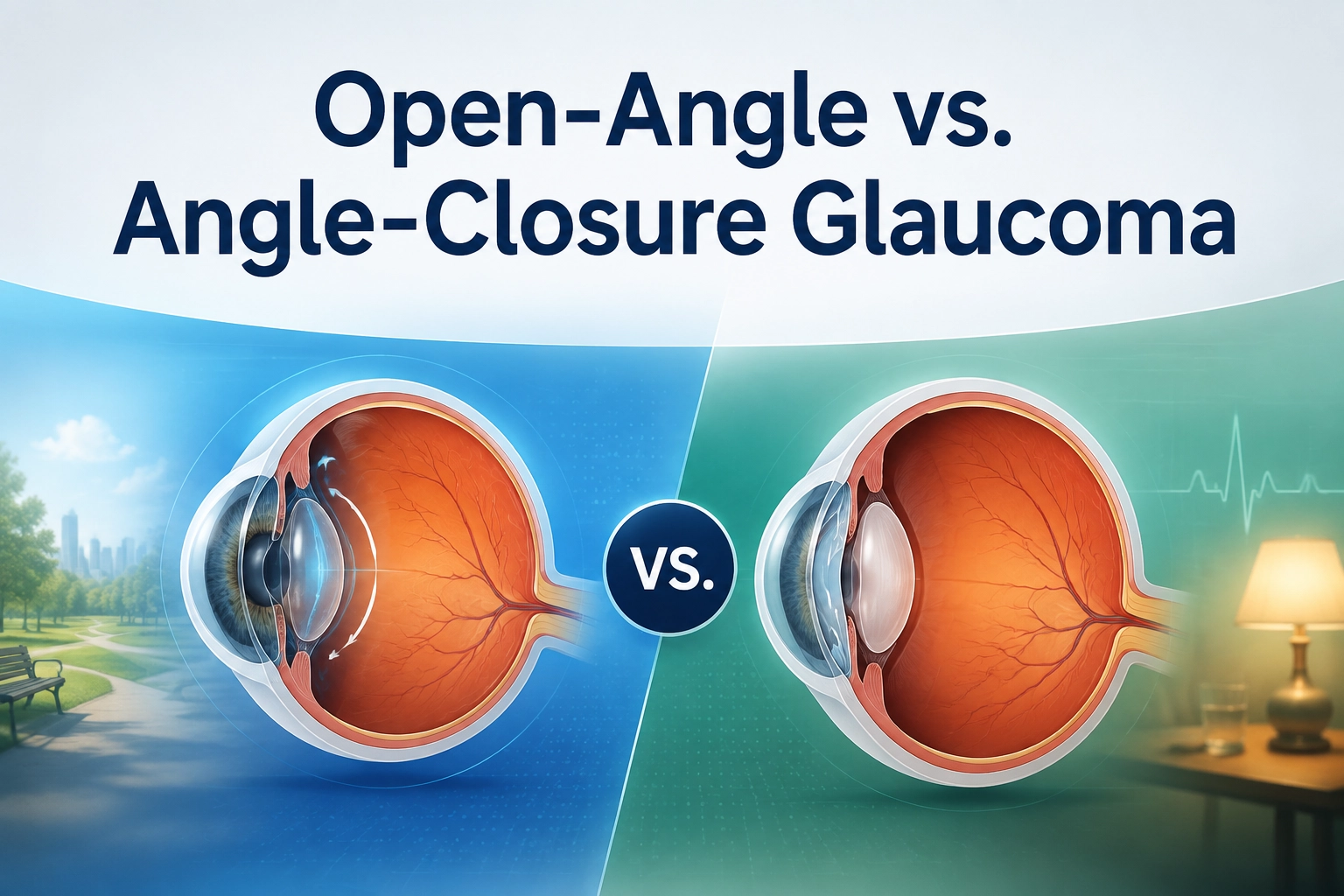
Modern macular degeneration treatment has significantly improved long-term retinal care for many patients. Anti-VEGF therapies and other medical advances are helping more individuals preserve usable vision for longer periods than ever before. However, preserving retinal structure does not always restore comfortable daily vision.

For low vision clinics, rehabilitation centers, distributors, and special education providers, this shift is reshaping demand for more advanced low vision aids for macular degeneration that support reading comfort, independence, and long-term usability.
Why Persistent Functional Vision Loss Is Now a Long-Term Reality for AMD Patients
According to the National Eye Institute, age-related macular degeneration primarily affects central vision, making reading, driving, and recognizing faces increasingly difficult over time. Modern therapies can slow disease progression, especially in wet AMD, but many patients still live with chronic central vision impairment.
This means more individuals are now surviving longer with “functional low vision” rather than complete blindness. Clinically, this changes the rehabilitation focus from emergency vision preservation to long-term daily living support.
The modern AMD care pathway is no longer limited to medical treatment alone. Rehabilitation support has become an essential extension of patient care.
The Biggest Misunderstanding About Macular Degeneration Treatment
One of the most common misconceptions among patients is that treatment will restore normal vision. In reality, most macular degeneration treatment strategies are designed to slow disease progression and stabilize remaining vision rather than fully recover damaged central vision.
This is especially true with anti VEGF injections for macular degeneration, which are widely used to manage wet AMD. These injections often help reduce retinal fluid leakage and preserve existing vision, but many patients continue to experience persistent functional vision loss.
As a result, many ophthalmology clinics increasingly recommend low vision rehabilitation alongside medical management.
Professional Tip for Rehabilitation Providers:
Position low vision rehabilitation as a continuation of AMD care rather than a replacement for treatment. Patients are often more willing to adopt assistive technology when it is presented as part of a long-term independence strategy.
Why Reading Often Remains Difficult After Anti-VEGF Injections for Macular Degeneration
Even after successful retinal stabilization, many AMD patients still struggle with reading-related tasks. This occurs because central retinal damage may continue affecting fixation stability, contrast perception, and visual processing efficiency.
Common Reading Difficulties After Treatment
- Broken or missing letters:Words appear fragmented, with characters vanishing into a blind spot.
- Losing the line:Following a line of text across a page becomes a constant struggle.
- Slow reading speed:Deciphering each word takes longer, disrupting comprehension.
- Early visual fatigue:Reading for more than a few minutes triggers eye strain and mental exhaustion.
Why Optical Magnifiers Often Fall Short
Traditional dome or bar magnifiers enlarge text but do not address the underlying perceptual deficits. They cannot enhance contrast, read text aloud, or reduce the oculomotor stress that exhausts the paracentral retina. This is why demand continues growing for more advanced reading devices for macular degeneration that combine magnification with digital enhancement.
Modern electronic magnifiers for macular degeneration support reading comfort through:
- Adjustable magnification with smooth zoom
- High-contrast display modes (white-on-black, yellow-on-blue)
- OCR text recognition that reads content aloud
- Larger viewing areas that reduce constant panning
- Built-in line markers and screen masks that guide the eye
Functional Vision Rehabilitation Is Becoming Essential in Modern Macular Degeneration Treatment
Today’s low vision rehabilitation environment extends far beyond simple magnification. Clinics and rehabilitation centers are increasingly prioritizing technologies that support sustained functional vision during everyday activities.
What Modern Rehabilitation Technology Should Offer
- Comfortable long-duration reading
- OCR-assisted document access
- Audio-supported reading workflows
- Improved contrast enhancement
- Large-screen viewing
- Classroom and workplace accessibility
- Independent daily living support
This evolution is especially important as more providers recognize that AMD rehabilitation is not solely about helping patients “see bigger.” It is about helping them maintain independence and continue participating in daily life.
What to Look for in a Low Vision Aid
For low vision professionals, this also changes purchasing priorities. Devices must now balance:
- Ease of training
- Reading comfort
- Multi-scenario usability
- Portability
- Long-term adoption potential
How Zoomax Supports AMD Patients Based on Functional Vision Loss Patterns
In modern low vision rehabilitation, AMD is increasingly understood not only by disease stage, but by functional vision loss patterns. Patients with similar clinical diagnoses may experience very different challenges in reading, mobility, recognition, and visual comfort.
For clinics, rehabilitation centers, and distributors, this functional classification provides a more practical framework for selecting assistive technologies that match real-world patient needs.
Below, AMD-related visual challenges are grouped into three dominant functional categories, each aligned with a specific rehabilitation focus and Zoomax solution.
Reading-Dominant Functional Vision Loss
Recommended Solution: Zoomax Snow Pad
Many AMD patients experience their earliest and most disruptive limitations in reading and close-up visual tasks.
In daily life, this often appears as:
- Words appearing broken or incomplete while reading books or newspapers
- Losing place frequently when reading multi-line text such as articles or letters
- Feeling visually exhausted after only a few minutes of sustained reading
- Difficulty writing on paper due to misalignment between vision and hand movement
- Challenges copying text, filling forms, or maintaining writing accuracy
These issues significantly impact independence in activities such as reading mail, completing paperwork, handwriting notes, and engaging in long-form reading.
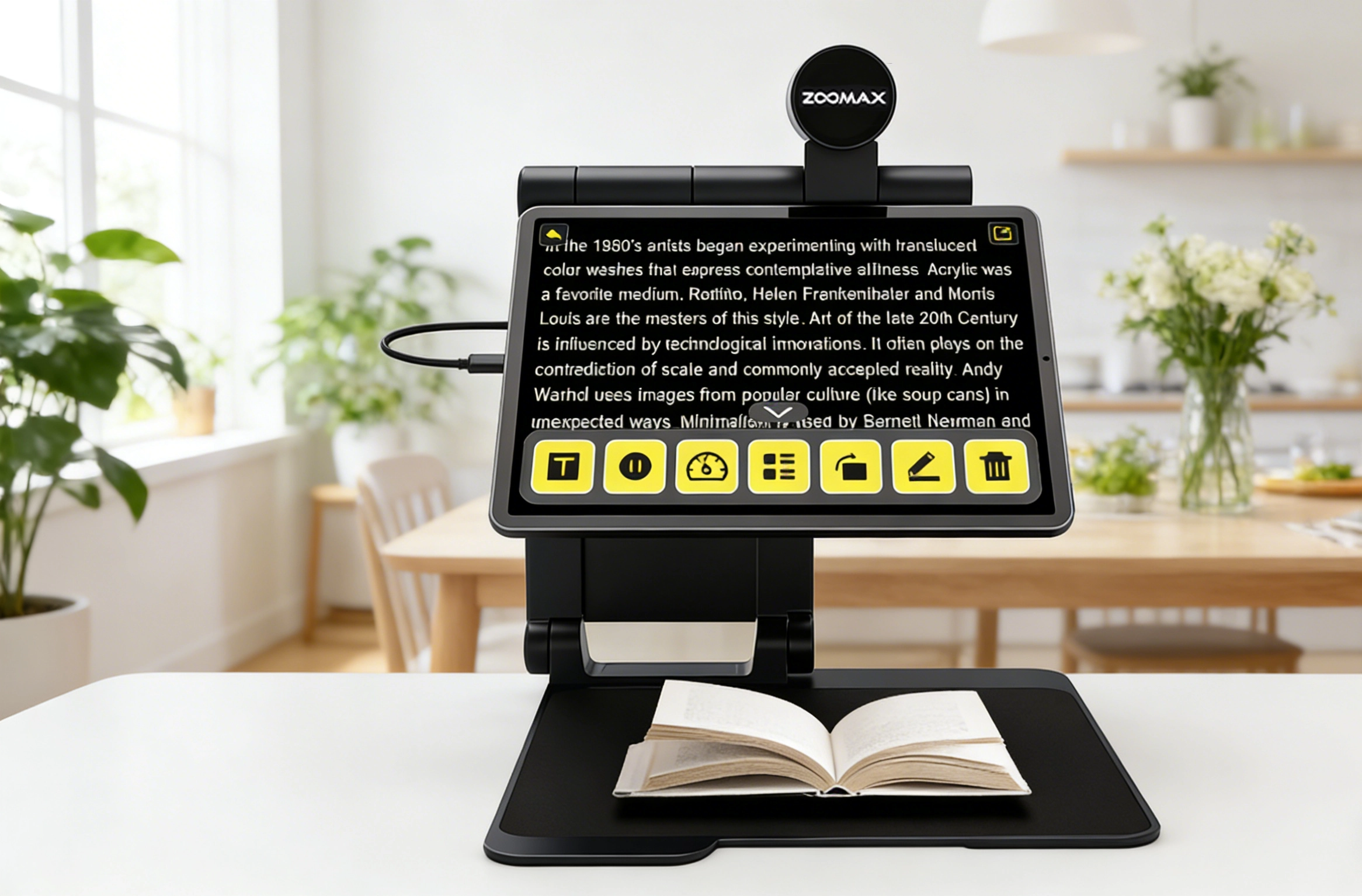
Snow Pad tablet screen magnifier is particularly suited for these scenarios where sustained reading and writing support are required in the same workflow. Its Full HD display allows users to see an entire document at once while magnifying the active reading area, preserving context and reducing the disorienting effect of constant scrolling. Customizable line markers and horizontal/vertical reading masks help the eye track text without skipping lines — a common frustration with scotoma-driven reading. For extended tasks, the built-in OCR text-to-speech engine reads entire documents aloud in a natural voice, completely bypassing the damaged macula and eliminating reading fatigue. In addition, the split-screen viewing feature allows users to simultaneously compare or reference distant and near content within the same visual field. This reduces the need for frequent gaze shifting between different focal distances, which is a common source of visual fatigue for AMD patients during reading, writing, and document-related tasks.
Central Vision Loss Dominant Functional Deficit
Recommended Solution: Zoomax Luna Eye
As central vision loss advances, daily visual challenges become more than inconveniences — they turn into genuine barriers:
- A persistent blur or dark patch sits right at the center of focus.
- Recognizing faces and reading facial expressions feels unreliable.
- Perceiving details becomes a struggle, or even impossible.
- Writing and filling out forms become uncertain — the pen tip often vanishes into the blind spot.
- Shifting between near and distance tasks triggers fatigue and disorientation.
Zoomax Luna Eye desktop cctv magnifier is built to address these near and distance vision difficulties in one integrated system. Its 24-inch HD display, combined with three functional modes — distance-view, near-view, selfie — helps bring the center of sight back into focus across a wide range of daily situations. Distance-view mode captures faces, window views, and distant scenes, displaying them with adjustable magnification and contrast so users can see clearly while maintaining a natural sitting posture. For close-up work, near-view mode delivers crisp, magnified text and documents; the generous workspace beneath the camera allows users to watch the pen tip in real time while writing, signing checks, or completing forms, restoring the visual feedback that central vision loss takes away. Selfie mode lets users point the camera toward themselves for daily grooming tasks such as applying makeup or shaving, making personal care routines independent and precise.
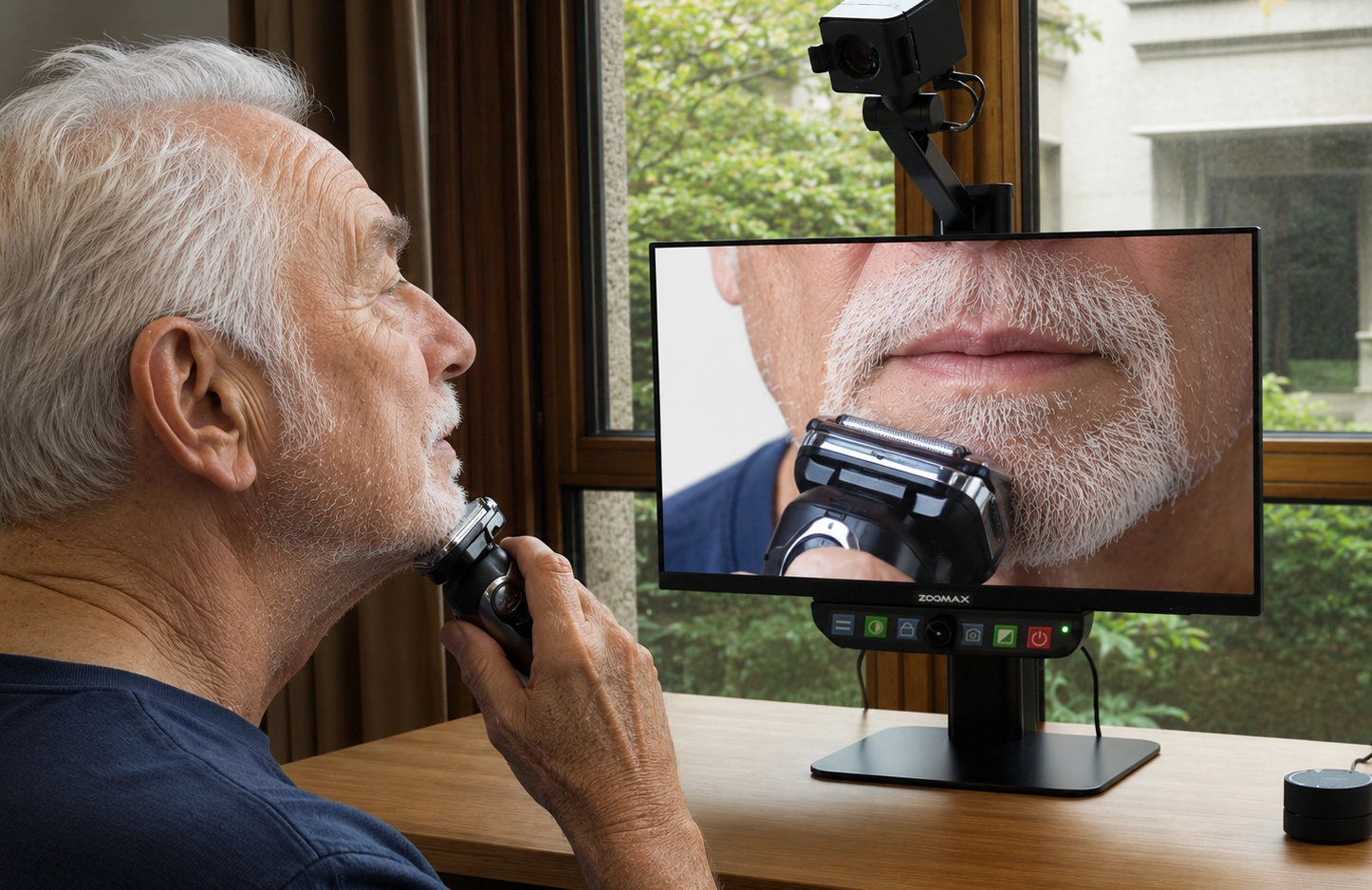
The hands-free design also supports personal hobbies such as magnifying knitting details or assembling small, intricate puzzle pieces. Large, tactile buttons make operation intuitive and straightforward, even for older users, while the hands-free desktop setup significantly reduces the fatigue often associated with handheld magnifiers. Combining a large-screen, multi-mode viewing experience with the flexibility to move it wherever clear vision is required, Luna Eye helps patients stay connected to faces, content, and the everyday paperwork that keeps life running smoothly.
Contrast Sensitivity Dominant Functional Loss
Recommended Solution: Zoomax Luna 6
Contrast sensitivity loss is often less noticeable in early AMD discussions but has a significant impact on real-world independence.
Patients typically describe a pattern where:
- Vision is acceptable in bright, controlled lighting environments
- Visual clarity declines sharply in dim, uneven, or high-glare conditions
- Object edges become harder to distinguish in cluttered environments
This directly affects everyday mobility and decision-making tasks such as:
- Reading restaurant menus in low or uneven lighting conditions
- Identifying products, shelf labels, or price tags while grocery shopping
- Quickly checking receipts, packaging details, or expiration dates during errands
In these situations, visual demands are typically short, fast, and task-oriented, requiring immediate clarity rather than extended reading support.

Zoomax Luna 6 is designed for this type of mobility-based visual assistance, combining fast auto-focus, near-to-far viewing flexibility, and handheld portability. Users can quickly switch between reading close-up labels (such as medication instructions or receipts) and viewing slightly distant targets (such as shelf tags or store signage) without complex setup or adjustment.
This makes it particularly suitable for real-world environments where AMD patients need quick decision-making support during daily shopping, navigation, and on-the-go visual checking tasks.
Product Specification Overview for AMD Rehabilitation Programs
Feature | Luna 6 | Snow Pad | Luna Eye |
Primary Functional Focus | Mobile reading + writing support | Integrated near + distance low vision rehabilitation system | Desktop near + distance+selfie magnification for central vision loss |
Typical AMD Stage | Early–moderate AMD | Moderate–advanced AMD | Moderate–advanced AMD |
Usage Environment | Daily mobility (home, shopping, outdoor tasks) | Home, classroom, office, rehabilitation center | Home, clinic, rehabilitation center |
Viewing System | Handheld + flip-out stand mode | Dual system: near magnification + dedicated distance viewing camera | Triple-mode desktop: distance-view, near-view, selfie |
Near Reading | Excellent for quick spotting/short-term reading | Strong (document reading on writing board + near camera support) | Strong (near reading mode with generous workspace under camera) |
Distance Viewing | Basic (labels, shelves, signage) | Strong (built-in distance camera for board/room/TV viewing) | Strong (far viewing mode with adjustable magnification and contrast) |
Writing Support | Yes — supports handwriting & form filling using stable stand mode | Yes — writing board enables paper/notebook placement for guided writing | Yes — large workspace enables real-time writing feedback for signing, forms, and notes |
OCR / Text-to-Speech | No | Yes | No |
Key Strength | Fast switching between reading, writing, and mobility tasks | Complete near-to-distance rehabilitation workflow with cross-tablet compatibility | Ultra-lightweight, one-hand portable desktop; hands-free for reading, writing, hobbies, and personal care |
Why Low Vision Clinics and Distributors Need Better AMD Rehabilitation Solutions
Living with functional vision loss does not mean giving up independence. The right low vision aids for macular degeneration can bridge the gap between what the retina can no longer do and what daily life demands. As the AMD population grows, more patients and families are discovering that modern electronic magnification, OCR reading support, and desktop or portable viewing technology can restore access to reading, writing, social connection, and personal management.
For eye care professionals committed to supporting this journey, offering devices that address different functional loss patterns — rather than a single generic magnifier — creates meaningful, lasting value for patients navigating the long road of AMD.
As one of the most professional low vision aid suppliers, Zoomax has over 20 years of experience in low vision assistive technology development and continues supporting distributors, rehabilitation providers, and clinical partners across more than 80 countries.
Zoomax product ecosystem is supported by:
- CE, FDA, and RoHS certifications
- Ongoing R&D and patented technologies
- Global distributor cooperation experience
- Localized technical and after-sales support
- Product training and marketing support
- 2-year warranty services
Beyond manufacturing devices, Zoomax continues working with partners to support sustainable low vision rehabilitation solutions for the growing global AMD population.