Why UV Safety Awareness Month Matters More Than Ever
The summer of 2026 is bringing intense heatwaves and extreme weather patterns across North America, southern Europe, South Asia, and East Asia. These conditions are elevating ground-level ultraviolet radiation and making outdoor exposure increasingly hazardous. As a result, the case for robust ocular protection has never been more urgent.

This is precisely why UV Safety Awareness Month, observed each July and championed by health agencies worldwide, carries exceptional weight this year. For our industry, the month serves as a powerful starting point — but the need for vigilant eye protection extends across the entire summer and throughout the year. It is not only a seasonal reminder but a strategic moment to realign clinical and commercial priorities around UV Safety Awareness Month 2026, with an eye toward sustained, long-term patient care.
Recent studies and health authorities continue to highlight that a significant portion of cataract cases—up to 10% globally—can be attributed to or worsened by excessive UV exposure. In a year of amplified environmental risk, the link between cataracts and UV exposure becomes even more consequential for patient education and clinical outreach. Yet, public awareness of UV eye protection remains disproportionately low compared to skin protection, making preventive education one of the most cost-effective interventions eye care providers can champion.
While prevention remains essential, accumulated UV damage over decades often exceeds what protective measures alone can fully address. This heightened context serves as the narrative starting point: when prevention efforts face their limits, the focus must expand to functional vision rehabilitation. The conversation around UV Safety Awareness Month must therefore evolve from simply advocating sunglasses to also addressing the long-term needs of those already living with UV-related vision loss.
The Long-Term Impact of UV Damage on Visual Function
Moving from awareness to clinical reality, it is critical to recognize that ultraviolet radiation causes cumulative and often irreversible changes to ocular tissues. Chronic exposure accelerates lens opacification and induces degenerative alterations in the retinal pigment epithelium and photoreceptors. Even when cataract surgery successfully removes the clouded lens, the retinal damage sustained over decades may remain, leaving patients with persistent functional deficits.
The most clinically significant consequences manifest not merely as reduced acuity, but as debilitating distortions in daily visual performance: disabling glare sensitivity, loss of contrast sensitivity, and profound difficulties with sustained reading. These symptoms define “low vision” more accurately than a Snellen chart ever could, because they directly erode a person’s ability to manage medications, recognize faces, or navigate indoor spaces comfortably.
These functional impairments form the critical bridge between UV awareness and low vision rehabilitation. Eye care professionals who understand this continuum are better equipped to recommend assistive technologies long before a patient’s vision reaches legal blindness. The goal shifts from correcting optics to rebuilding practical capabilities.
Which Patient Populations Face the Greatest UV Risk?
Recognizing that UV damage is not uniformly distributed across the population helps clinicians and procurement specialists anticipate where demand for low vision services will concentrate.
Older adults, by virtue of lifelong cumulative exposure, represent the largest demographic affected by UV-related cataract and age-related macular degeneration (AMD). For this group, low vision rehabilitation is often the most meaningful form of ongoing care. When spectacle corrections and surgical interventions reach their limits, electronic magnification, contrast enhancement, and text-to-speech become indispensable.
Individuals with macular degeneration are especially vulnerable to phototoxic retinal stress. Their urgent need for devices that restore contrast sensitivity and reduce glare directly aligns with the capabilities of modern digital low vision aids.
Outdoor workers — farmers, construction crews, fishermen — experience daily UV doses far above the general population. The elevated incidence of pterygium and early cortical cataract in this cohort creates a dual requirement for uv light eye protection and accessible rehabilitation tools. Any practice serving these communities must consider stocking portable, durable, and easy-to-use assistive devices.
Children and adolescents with high UV exposure may not present immediate pathology, but the cellular damage accumulated during childhood sharply raises the risk of future ocular disease. Simultaneously, students with congenital or early-onset low vision need classroom-ready solutions that support active learning. These converging needs make special schools and resource centers a natural entry point for low vision education and device integration.
From Prevention to Rehabilitation: The Growing Need for Low Vision Technology
Building on the needs of these high-risk groups, it becomes clear that while UV-blocking lenses, wide-brimmed hats, and public health campaigns meaningfully reduce risk, they cannot reverse cataracts that have already matured or retinal scars that have already formed. The essential question for our field is no longer simply “How do we protect the eyes?” but “After taking every reasonable preventive measure, how do we help those who still struggle to read, write, and engage with their world?”
Answering that question requires a shift in perspective. Low vision rehabilitation is not a single intervention but a comprehensive, multidisciplinary process. It may begin with a thorough functional assessment to understand exactly how vision loss affects a person’s daily life, followed by strategies that span multiple domains: environmental modifications to reduce glare and improve lighting at home, orientation and mobility training for safer navigation, structured exercises to strengthen the use of residual vision, and counseling to support emotional adjustment. The core objective throughout is not to restore lost visual acuity, but to maximize functional independence — enabling someone to read a restaurant menu, manage household correspondence, recognize a grandchild’s expression, or follow a classroom whiteboard with confidence.

Within this broader framework, assistive technology has become an increasingly vital component. The evolution from traditional optical magnifiers to intelligent digital devices — offering continuous zoom, customizable contrast modes, OCR text-to-speech, and image freeze capabilities — has fundamentally expanded what patients and clinicians can achieve together. These tools do not replace the human elements of rehabilitation; they amplify them, giving individuals the means to apply newly trained skills in real-world situations. When selected thoughtfully and integrated into a coordinated care plan, digital low vision technology turns rehabilitation goals into daily realities.
What Eye Care Professionals Should Look for in Modern Low Vision Devices
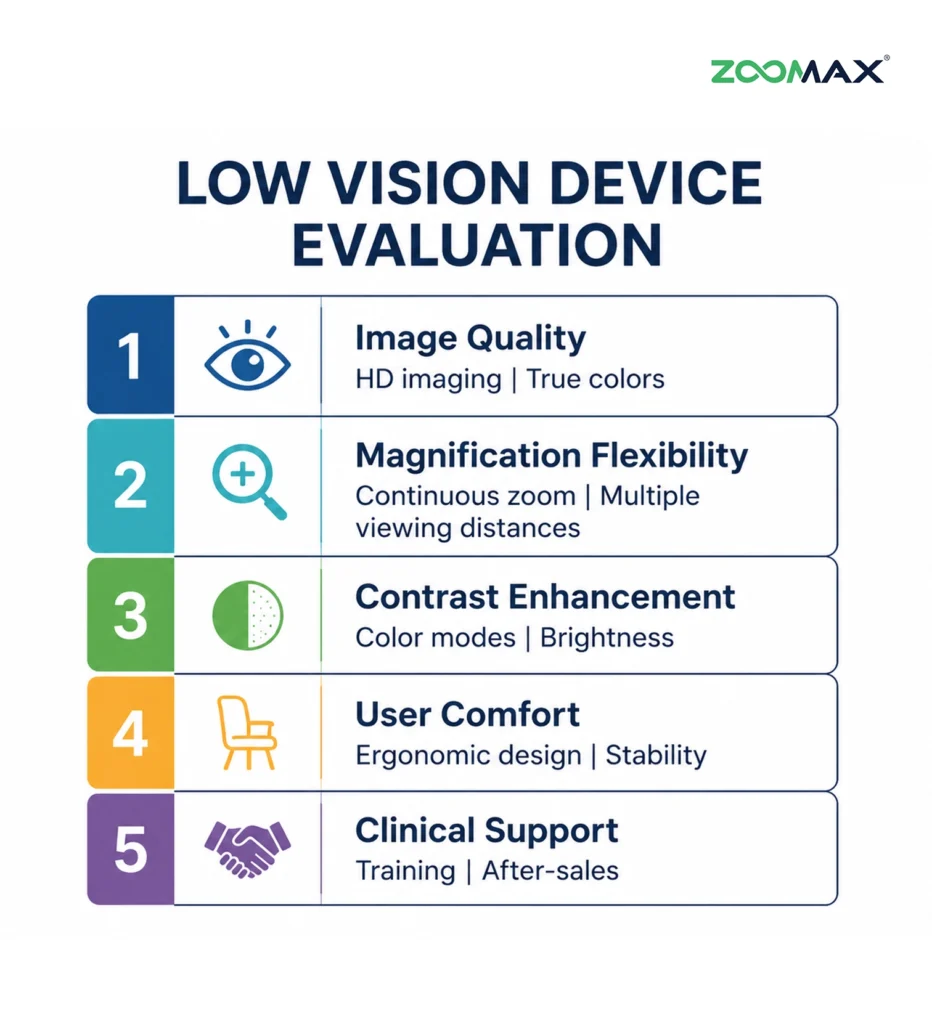
Procurement decisions in low vision care require a structured, evidence-based approach. The following criteria define devices that deliver consistent clinical results and high user satisfaction.
High-Resolution Imaging and True Color Rendering
Devices must provide crisp, pixel-free images that reduce visual fatigue during extended use. For tasks such as reading medication labels, identifying currency, or interpreting color-coded charts in school, accurate color reproduction is non-negotiable. Look for HD-grade camera sensors and displays that maintain fidelity across magnification levels.
Flexible, Continuous Magnification Control
A common misconception is that higher magnification always yields better outcomes. In practice, smooth and continuous zoom — free of abrupt steps — allows the user to find the optimal balance between field of view and detail. The ideal device supports near, intermediate, and distance viewing, enabling a single unit to serve as a desktop magnifier, a distance viewer for presentations, and a portable aid for shopping.
Image Enhancement and High-Contrast Modes
Most low vision patients suffer from impaired contrast sensitivity or disabling glare. A professional-grade device should offer multiple contrast presets — black on white, white on black, yellow on blue, green on black, and others — plus edge enhancement and adjustable brightness. These features are particularly valuable for patients with AMD, diabetic retinopathy, or rod-cone dystrophies.
Ergonomics and Long-Duration Comfort
A device that is technically brilliant but physically uncomfortable will be abandoned. Weight, screen angle adjustability, handle design, and stand stability directly influence clinical adherence. For elderly users or those with hand tremors, large tactile buttons, touchscreen simplicity, and a stable docking system are essential. Rehabilitation professionals should test devices in the same postures and durations their patients will use.
Standardized Evaluation Framework
We recommend that institutional purchasers adopt a formal assessment checklist covering: image quality at multiple magnifications, number and customizability of contrast modes, latency of live view and freeze functions, OCR and text-to-speech performance, connectivity (HDMI, USB), battery runtime, and the manufacturer’s track record in after-sales support and staff training.
While a rigorous evaluation framework helps identify technically sound devices, the ultimate measure lies in real-world performance. Many of the patients entering these settings — whether an ophthalmology clinic, a school resource room, or a rehabilitation center — arrive with visual deficits that can be traced, at least in part, to years of cumulative UV exposure. This is where specialized low vision technology providers play a vital role.
How Zoomax Helps Clinics, Schools, and Rehabilitation Centers Deliver Better Outcomes
As a developer and manufacturer dedicated exclusively to low vision technology, Zoomax delivers solutions that map directly to the clinical, educational, and commercial environments our partners operate in.
In Clinical Settings
Ophthalmologists and optometrists can integrate Zoomax devices directly into the examination lane. Portable evaluation kits allow functional vision assessments to occur during the same visit as the medical eye exam, shortening the path from diagnosis to low vision rehabilitation. Immediate hands-on experience with a digital magnifier often increases patient acceptance and follow-through, while providing practitioners with a differentiated service offering.
In Educational Environments
In Rehabilitation Programs
Rehabilitation centers that embed Zoomax technology into their daily living skills training report higher patient engagement. From reading oven dials and prescription bottles to managing personal finances, the practical gains translate into measurable improvements in independence and quality of life. Our technical team collaborates with therapists to customize training protocols, ensuring that device use becomes a natural part of the rehabilitation journey.
For Distribution Partners
We understand that a robust solution for low vision requires more than hardware. Zoomax provides reliable supply chains, technical service training, co-branded marketing materials, and direct clinical support — all designed to help our distributors serve their customers with confidence. For businesses seeking a reliable entry into the low vision supplies category, our partner program minimizes risk while maximizing clinical relevance.
Zoomax’s partner ecosystem is built on three pillars: consistent product availability, clinical education resources, and responsive after-sales support. When evaluating a low vision device brand, request evidence of ongoing software updates, availability of spare parts, and real-world case studies from similar practice settings.
For professionals building or expanding low vision services, selecting the right device for each patient population is critical. The table below maps Zoomax’s core product lineup to the high-risk groups and clinical scenarios discussed throughout this article.
Zoomax Product Recommendations by Patient Population and Use Case
Patient Population | Primary Needs | Recommended Zoomax Devices | Key Features for This Group |
Older Adults with AMD or Cataract-Related Low Vision | High-contrast reading, medication label viewing, glare reduction | Luna 6, Luna Eye,Luna HD 24 Pro | Multiple contrast modes, large tactile buttons, stable docking station, HD imaging with true color rendering |
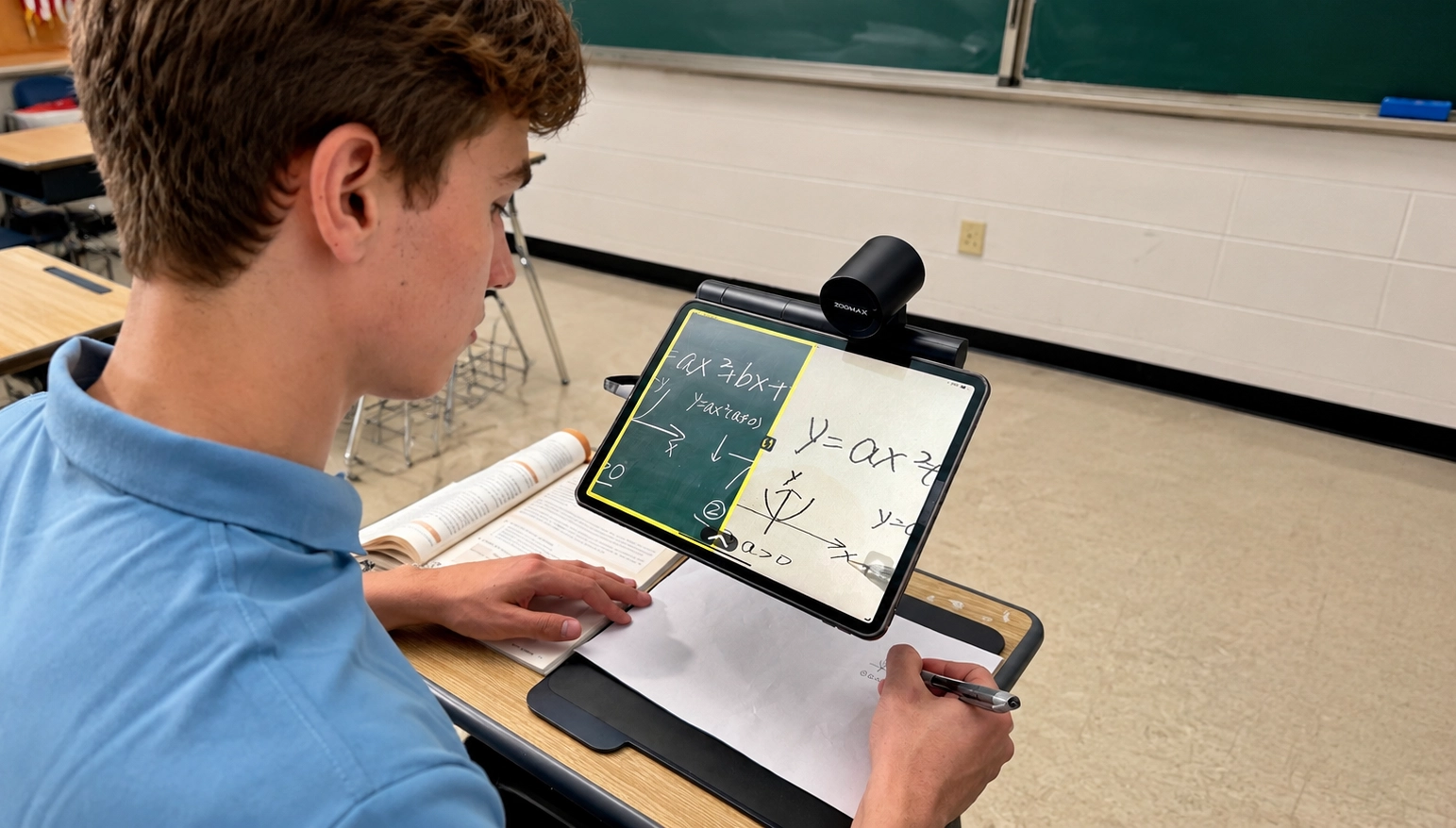
Students with Congenital or Early-Onset Low Vision | Classroom board viewing, textbook reading, exam participation | Snow Pad, Snow 12 & Snow Eye | Portable design, near and distance viewing, image freeze, OCR text-to-speech for lengthy reading tasks |
Outdoor Workers with UV-Related Ocular Surface Disease | Portable magnification, glare control, durable build for frequent use | Luna S, Luna 6 | Lightweight & pocket-size, high-contrast modes for bright environments |
Rehabilitation Centers (Mixed Patient Profiles) | Multi-purpose device covering near, intermediate, and distance tasks | Snow Pad, Luna Eye | Continuous zoom across distances, customizable contrast presets, easy integration into daily living skills training |
A single versatile device can often serve multiple patient profiles within a clinic or school setting, reducing inventory complexity while maximizing clinical flexibility. When procurement decisions are guided by both patient needs and operational efficiency, low vision services become more sustainable and more impactful.
Building Stronger Low Vision Services During UV Safety Awareness Month
July’s UV Safety Awareness Month provides an authentic, service-oriented platform for clinics, special schools, rehabilitation centers, and distributors to deepen their community relationships.
Eye care providers can organize UV-related eye health screenings and functional vision assessments, helping individuals who may not yet identify as “low vision” understand their own visual status. When such events are accompanied by live demonstrations of assistive technology, attendees gain a tangible sense of what modern devices can do for their daily lives. The goal is discovery, not pressure: people should leave thinking, “I didn’t know help like this existed.”
Distributors who equip their clinical partners with demonstration units, educational posters, and short-form video content for social media enable a wider reach. A thoughtful blend of in-office materials and digital storytelling amplifies the message that vision loss support is available, approachable, and effective.
Ultimately, the most respected partners in our field are not those who close the quickest sale, but those who consistently show up with useful knowledge, reliable products, and genuine care. When professionals and organizations invest in meaningful public engagement during UV Safety Awareness Month, they lay the foundation for lasting trust and stronger referral networks — benefits that endure long after July ends.