Key Takeaways
- For people with low vision, transportation barriers go far beyond the inability to drive—they affect spontaneity, safety, and independence in daily life.
- Recent milestones, such as Tesla’s Cybercab entering public service in Austin, signal a shift from testing to real-world use, but true accessibility is still a work in progress.
- A well-designed autonomous ride could offer a more predictable experience than traditional taxis, reducing the stress of finding the car, confirming the route, and exiting safely.
- Real inclusion requires more than self-driving technology—it demands user-centered design, multimodal feedback, and co-creation with the low vision community.
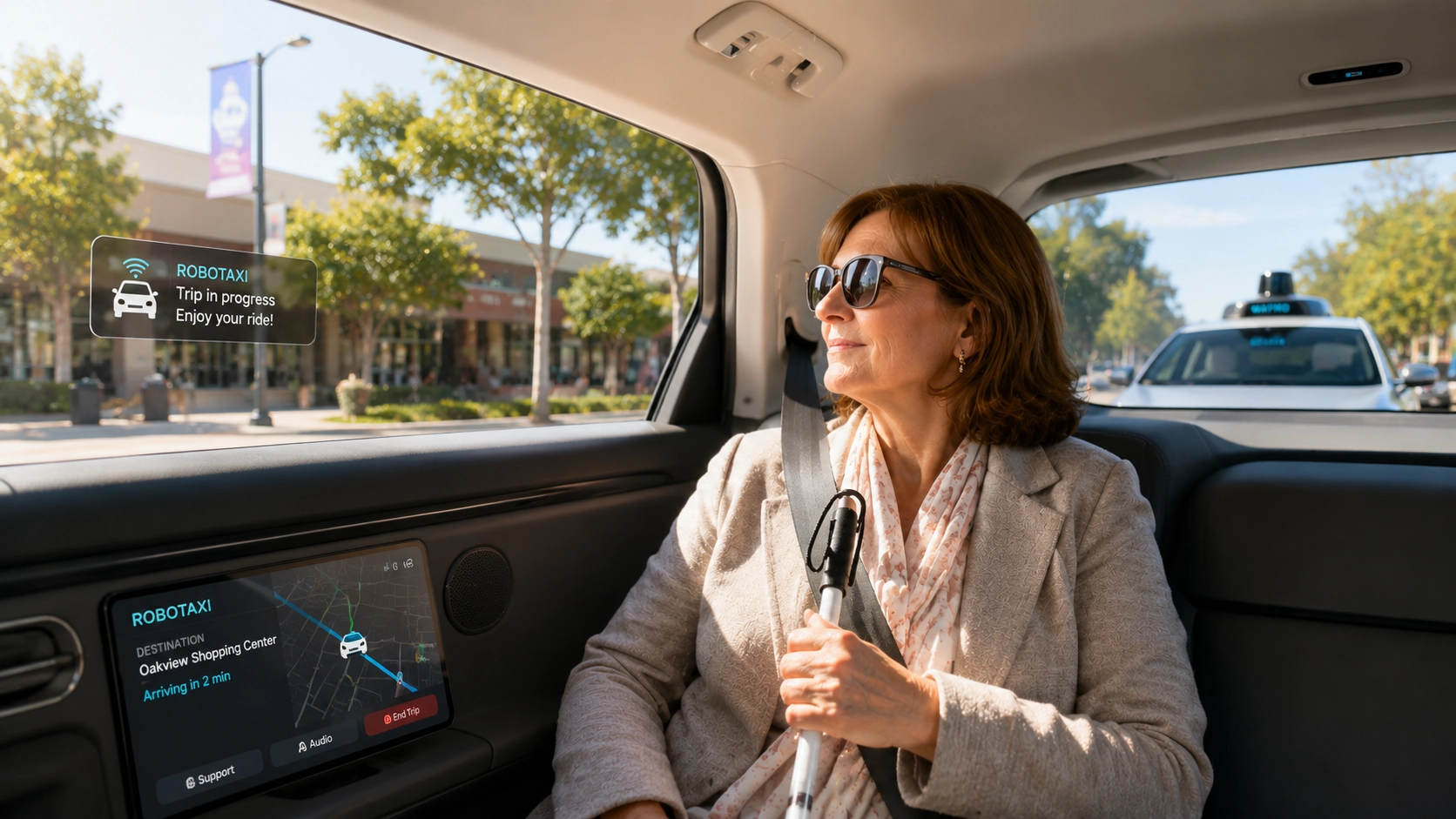
“You have arrived at your destination. Please collect your belongings and have a wonderful day.”
For Mary, a woman in her late 60s living with age-related macular degeneration (AMD), hearing that synthetic voice wasn’t just a notification—it was the sound of a small victory. For years, a simple trip to the shopping mall required coordinating schedules with her daughter or enduring a complex, anxiety-inducing journey on public transit. But today, she had hailed a self-driving taxi.
However, this wasn’t simply a matter of luck. While robotaxis have been appearing in pilot programs across the globe, truly accessible self driving cars for visually impaired are still far from “plug and play” for everyone. Mary had spent weeks preparing. She participated in a community orientation program to understand how the app worked with her screen reader, and for her first few rides, she invited a family member along for moral support.
Mary’s story highlights a profound truth about the modern world: for the estimated 2.2 billion people globally living with a vision impairment (WHO), the hardest part of daily life often isn’t the destination—it is the journey.
Why Transportation Is Still One of the Biggest Challenges for People with Low Vision
To understand why the buzz around autonomous vehicles (AVs) is so intense within the low vision community, we first have to understand the daily reality of getting around.
For the vast majority of people, driving a car represents freedom. It is the ability to decide at 10 PM that you want to take a drive to clear your head, or to accept a spontaneous dinner invitation across town. For individuals with low vision, driving is rarely a safe or legal option, and that freedom is often replaced by a heavy reliance on others and a constant negotiation with logistics.
The barriers are numerous:
- The “Last Mile” Problem: Even when public transport is available, navigating from the bus stop to the final destination can be visually taxing and unsafe.
- The Scheduling Burden: Paratransit services, while vital, often require booking 24 to 48 hours in advance. There is no room for spontaneity or human unpredictability.
- Nighttime Anxiety: Reduced contrast sensitivity and glare from headlights make evening travel particularly stressful, often forcing people to stay home after dark.
- The Emotional Cost: Many low vision individuals express a deep sense of guilt or frustration at “always being the one who needs a ride.”
Ultimately, what is lost is not just the ability to drive a car, but the autonomy to choose when and how to live. This is why the recent advancements in autonomous mobility feel less like a car upgrade and more like a social equalizer.
Why Are People Talking About Self-Driving Cars Again?
After years of being confined to sci-fi movies, the conversation around autonomous vehicles has shifted. In 2025 and 2026, we are no longer asking “if” it will happen, but “how” it will serve specific communities.
On September 4, Tesla’s Cybercab officially began carrying public passengers in Austin, Texas—marking the first time the vehicle has operated on public roads in a commercial capacity. This milestone moves the conversation from “testing” to “serving,” underscoring how quickly autonomous ride-hailing is becoming part of everyday urban mobility.
It is also the latest sign of a broader shift: while fully autonomous, private car ownership is still some years away for most people, Robotaxis (shared autonomous vehicles) have already entered commercial operation in several international hubs, from parts of the United States to China.
What changed?
The perception systems that power these vehicles have become vastly more sophisticated. They can now process thousands of data points per second, identifying pedestrians, cyclists, and sudden obstacles with reaction times that often surpass human drivers.
However, it is crucial to distinguish between Assisted Driving and Full Automation.
- Assisted Driving(like adaptive cruise control or lane-keeping) still requires a licensed driver to be alert and ready to take over. This is not a viable solution for low vision.
- Full Automation(Level 4/5) means the vehicle handles the driving. For the first time in history, the “driver” is a passenger.
These principles function as built-in low vision driving aids, transforming the vehicle from a simple transport pod into a supportive companion. These innovations are moving the conversation away from “assistive technology for cars” and toward inclusive architecture for public mobility.
From Technology to Reality: How Autonomous Vehicles Could Make Everyday Life Easier for Low Vision
While traditional taxis and ride-hailing services have long been available to people with low vision, the everyday experience can still be full of small but stressful obstacles. Picture this: a passenger with limited vision books a ride through a standard app. When the car arrives, she has to spot the right vehicle among a row of similar cars, read the license plate, or call the driver to describe where she is standing. If the driver doesn’t notice her, or stops a few meters away, the situation becomes stressful before the journey even begins.
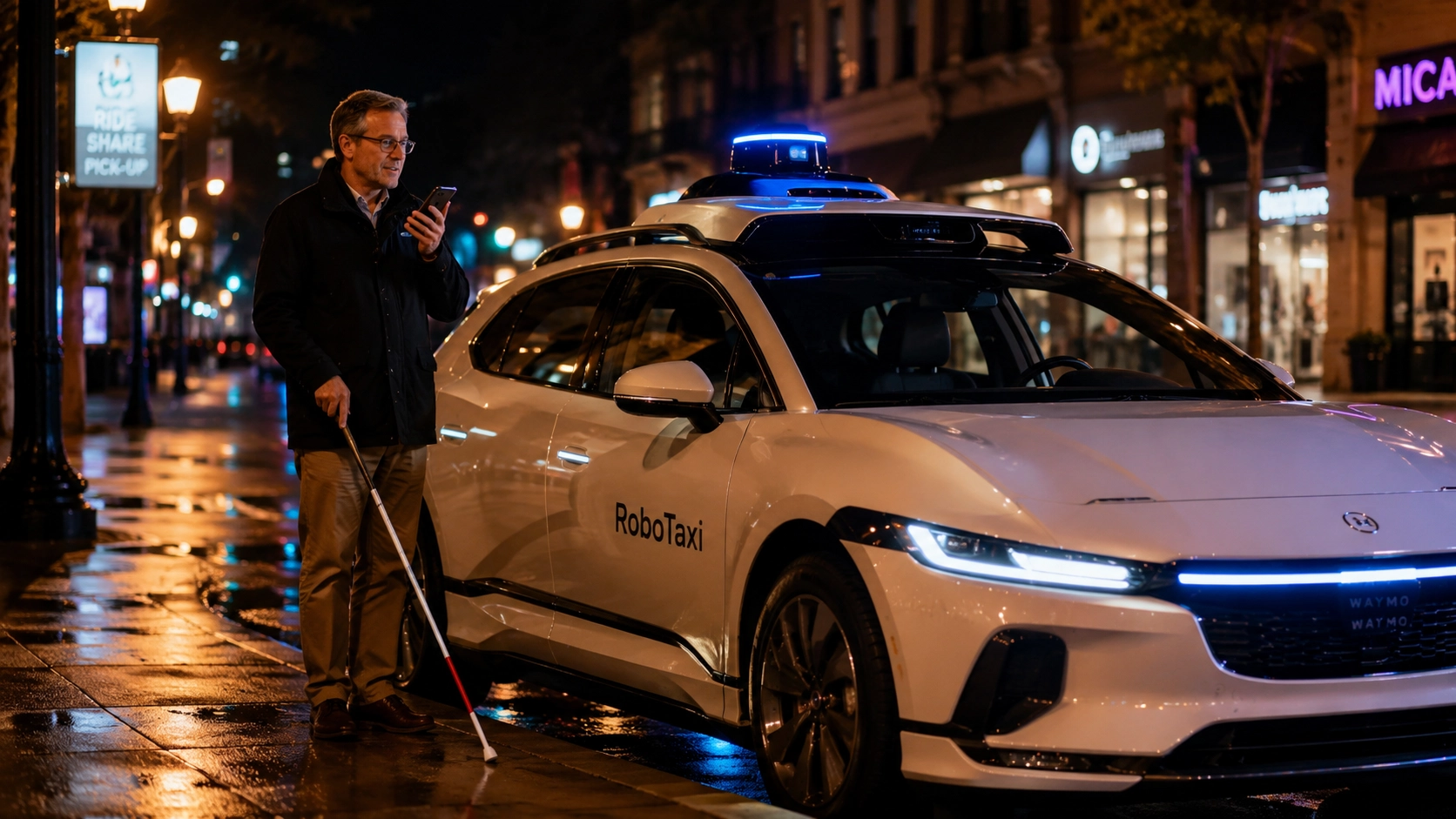
By contrast, a well-designed autonomous ride-hailing service could remove many of these friction points. The vehicle could locate the passenger through her phone, confirm her identity with a simple code or vibration, and guide her to the door with voice prompts. Once inside, she could hear the route and the estimated arrival time, without needing to explain her needs to a stranger or rely on visual recognition. The result is not just a ride—it is a predictable, repeatable experience that gives passengers greater confidence to travel on their own terms.
For people living with glaucoma, diabetic retinopathy, or similar conditions—those who retain some vision but struggle especially with night travel and visual recognition in unfamiliar environments—the true promise of the self-driving car isn’t the thrill of being in a “car without a driver.” It is the quiet restoration of a normal routine.
Imagine a future where a night out doesn’t end with a nervous wait at a dark bus stop. Instead, a vehicle arrives, confirmed by a personalized haptic vibration on your smartphone. It doesn’t just idle in the general vicinity; it communicates with your device to pinpoint your exact location, even if you’ve drifted slightly from the curb.
Researchers at institutions like MIT and the University of Michigan are currently studying how to make the interior of these vehicles accessible. The focus is shifting from merely “self-driving” to “user-centered” design.
Design principles being explored include:
- Multimodal Feedback: Using a combination of auditory announcements (“The car is now approaching the crosswalk”), tactile vibrations in the armrest (to signal a right turn), and large-print displays.
- Clear Communication: If the vehicle cannot find a safe drop-off point, it might ask the passenger via voice command: “Sidewalk is blocked ahead. Is it okay to stop 5 meters further?”
- Predictable Interiors: Designing handles, seatbelts, and control panels with high contrast and consistent tactile textures so the environment is intuitive to navigate by touch.
These innovations are moving the conversation away from “assistive technology for cars” and toward inclusive architecture for public mobility.
What Still Needs to Happen Before Autonomous Mobility Becomes Truly Accessible?
Despite the incredible momentum, we must remain realistic. The hardware working does not automatically mean the experience is accessible.
The emerging field of accessible autonomous mobility emphasizes that we cannot just “drop” a visually impaired person into a robotaxi and hope for the best. Mary’s preparation, mentioned at the beginning, proves that orientation and training are just as important as the sensors on the car.
The challenges requiring solutions include:
- The Locating Problem: How does the car find the passenger, and how does the passenger find the car in a crowded pickup zone?
- Trust and Feedback: In a standard ride, a sighted passenger can glance at the road ahead and anticipate why the car is slowing down or changing lanes. For a passenger with low vision, these sudden movements can feel disorienting without alternative cues. They need clear signals—visual, auditory, or haptic—to understand what the vehicle is doing and why, building trust in the system over time.
- Emergency Situations: What happens if the vehicle encounters sudden severe weather, a system malfunction, or an unexpected road closure mid-trip? Passengers with low vision need non-visual ways to receive clear instructions, such as voice-guided evacuation steps or direct audio connection to remote support staff.
- Safe Exit Assistance: When a ride ends, a sighted passenger can quickly check for approaching cyclists or pedestrians before opening the door. For someone with low vision, this is nearly impossible. Autonomous vehicles will need built-in systems—such as sensors that detect oncoming traffic and hold the door locked until it is safe, combined with audio confirmation—to ensure passengers can step out without danger.
To solve this, tech developers, transportation authorities, and disability advocates must co-design the future. This is not a feature checklist; it is a systems problem. The future of transportation isn’t just a competition for the best driving technology; it is a measure of our commitment to inclusive design. A vehicle is only truly “autonomous” when anyone can use it without help.
The Future of Independence Is Built One Innovation at a Time
The story of self-driving cars for the blind and low vision community is ultimately a story about agency. It is about the dignity of deciding to go to the pharmacy without a chaperone, or visiting a grandchild without a three-day notice.
While we wait for the roads to be filled with accessible robotaxis, the world of assistive technology is already working to bridge the gap. Innovation is not siloed. The same advancements in computer vision and sensor technology that power car cameras are also powering the next generation of wearable visual aids and electronic magnifiers. The haptic feedback being tested in car seats is found in smart canes. The voice-first interfaces of the car are mirrored in screen readers and smart glasses.
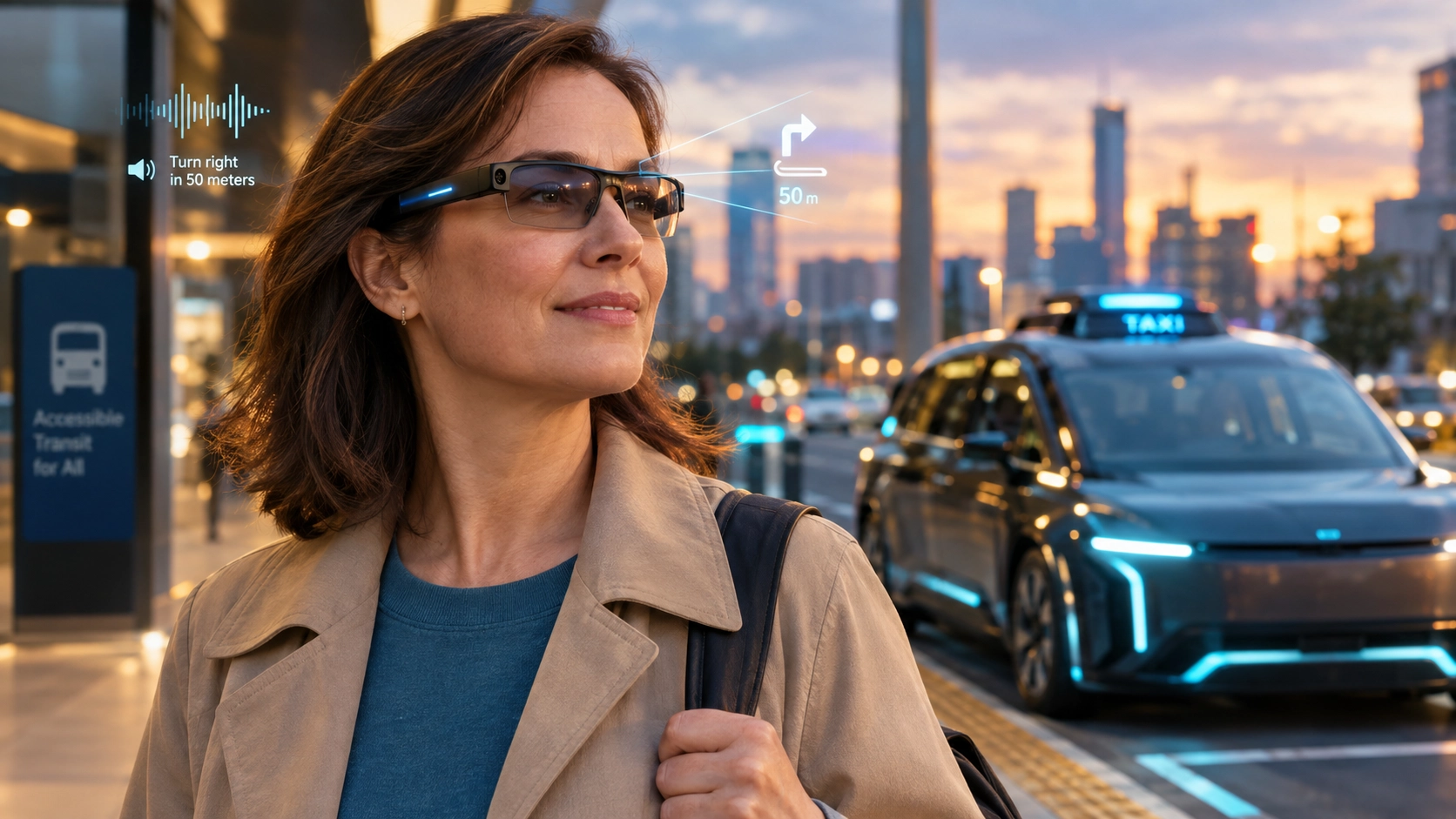
The future of accessible mobility will be an important part of the assistive technology ecosystem. It will need time to prove itself, but its era will come. Just as Zoomax and other assistive technology companies have continued to invest in electronic magnifiers, this future will be built through patient, user-centered innovation. A car can take you where you want to go; a Zoomax assistive devices for low vision can help you better discover the wonders of the destination.
The promise of autonomous driving is not about the car; it is about the passenger. It is about reclaiming the freedom to explore, to connect, and to live life on your own terms.
Important Safety Note: We do not encourage people with low vision to use autonomous vehicles at this time, even if such services are already operating in your area. Always pay attention to autonomous driving safety rules and use them cautiously with the accompaniment or consent of a family member. Protecting your life and safety comes first.